Direct answer
A mechanism-focused briefing on CJC-1295, Drug Affinity Complex chemistry, albumin association and growth hormone axis study design.
- CJC-1295 with DAC and shorter-acting GHRH analogues are chemically and kinetically distinct materials.
- Drug Affinity Complex chemistry is designed to form a covalent association with albumin and extend exposure.
- Growth hormone and IGF-I readouts are pulsatile, feedback-regulated and sensitive to sampling design.
What does DAC change?
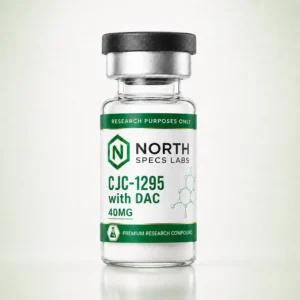
CJC-1295 is a modified growth hormone-releasing hormone analog. The Drug Affinity Complex component includes a reactive group intended to form a covalent bond with albumin after exposure, prolonging circulation compared with a short GHRH fragment. Materials sold with and without DAC should not be treated as the same test article.
The attachment changes mass, hydrophobicity, protein association and analytical behavior. Identity documentation must describe the full modified structure, not only the peptide backbone.
How can albumin association be studied?
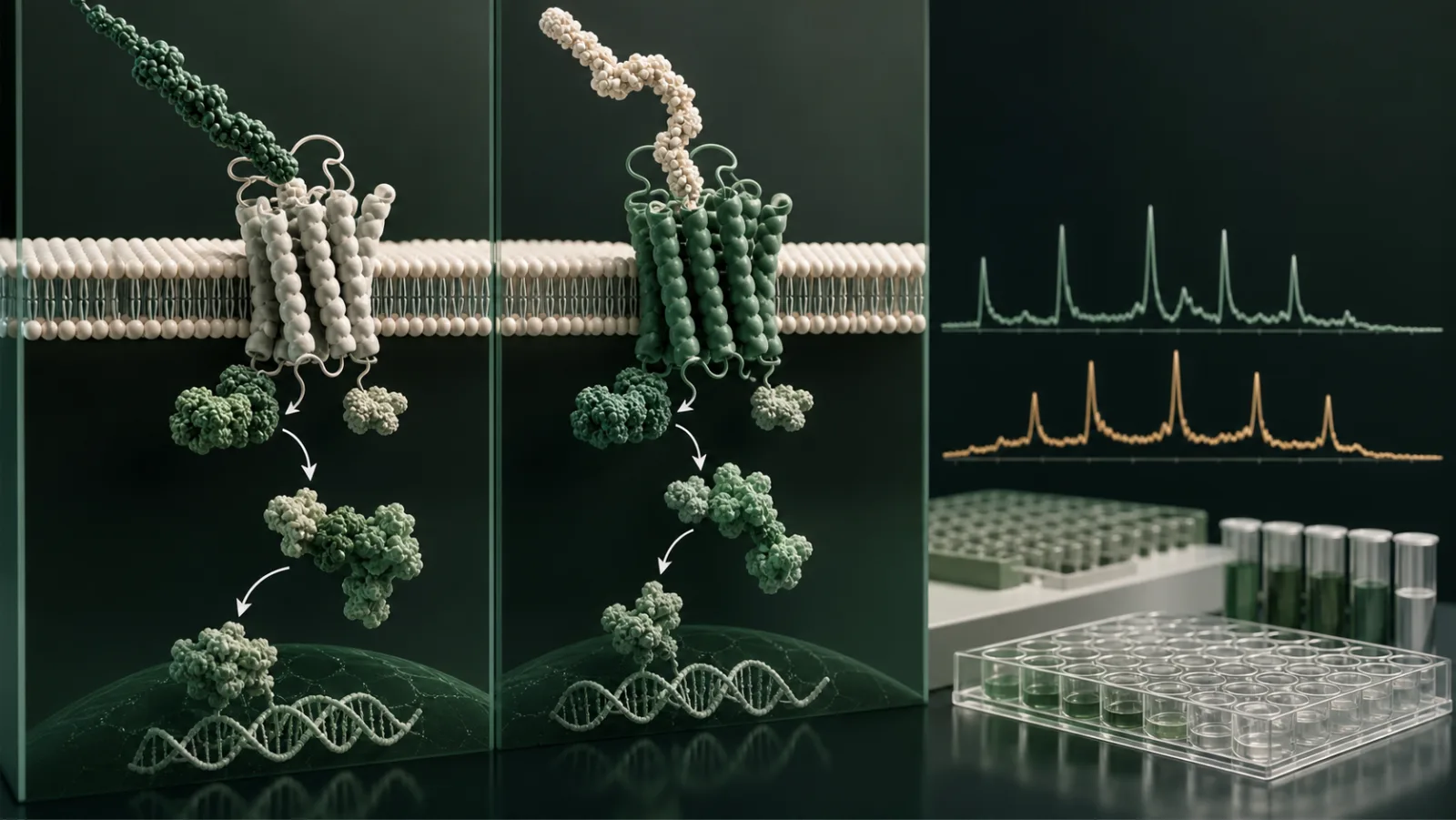
In-vitro experiments can compare incubation with albumin and other proteins, track free and protein-associated fractions, and use mass evidence to investigate covalent adduct formation. Species and source of albumin matter because reactive residues and binding environments can differ. Buffer pH, time and competing nucleophiles can change the reaction.
Recovery controls are essential because apparent loss of free peptide can reflect vessel adsorption, degradation or albumin association. A mass balance across fractions is stronger than one disappearing parent peak.
What complicates growth hormone axis experiments?
GHRH receptor response depends on pituitary context and downstream feedback. Growth hormone is pulsatile, and IGF-I integrates a longer signal. Sampling at one convenient time may miss peaks or confuse duration with maximal response. Experimental models should define receptor expression, baseline secretion and feedback conditions.
Compare a characterized short-acting GHRH analog and an appropriate vehicle. Report full time courses and exposure measurements where possible rather than inferring kinetics from one biomarker.
What limits the conclusion?
Early human pharmacology can describe measured exposure and hormonal effects under a study protocol, but it does not establish broad therapeutic use. Health Canada lists CJC-1295 among unauthorized peptides of concern. North Specs product links are provided only for legitimate laboratory research, with no personal-use or clinical recommendation.
Continue through the evidence
Methods and quality. Albumin Binding and Acylated Peptides: A Research Methods Guide, How to Read a Peptide Certificate of Analysis, HPLC Peptide Purity: How to Read a Chromatogram Without Overclaiming and LC-MS for Peptide Identity: Molecular Mass, Charge States and Sequence Evidence.
Connected peptide briefings. Growth Hormone Secretagogues: GHRH Analogues Versus Ghrelin Mimetics, Sermorelin and Tesamorelin: Comparing GHRH Analogues in Research, Research Peptides in Canada: A Laboratory Procurement Guide, Health Canada, Peptides and Research Use Only: What the 2026 Guidance Means, Shipping and Storing Research Peptides Across Canada, BPC-157 Research: Evidence Gaps and Replication-First Study Design, GHK-Cu Research: Copper Coordination and Experimental Design and Ipamorelin and Hexarelin: Ghrelin Receptor Selectivity in Research.
Sources and further literature
- Prolonged stimulation of growth hormone and IGF-I by CJC-1295Human pharmacology study of CJC-1295 from 2006; not a general-use recommendation.
- Health Canada: Think twice before injecting peptides bought onlineApril 2026 federal warning about unauthorized peptide products.
- ICH Q2(R2): Validation of Analytical ProceduresFramework for fit-for-purpose analytical procedures.
North Specs separates scientific education from product claims. Review primary literature, current regulations and institutional requirements before designing laboratory work.