Direct answer
A practical guide to interpreting peptide HPLC purity, peak area, wavelength, gradients and the questions a chromatogram cannot answer alone.
- HPLC area percent is a method-dependent measure of detected chromatographic components, not a universal statement of material composition.
- A useful chromatogram identifies the method, column, gradient, detection wavelength, injection and integration approach.
- Identity, peptide content, water and counter-ion measurements require evidence beyond one purity trace.
What does HPLC purity actually measure?
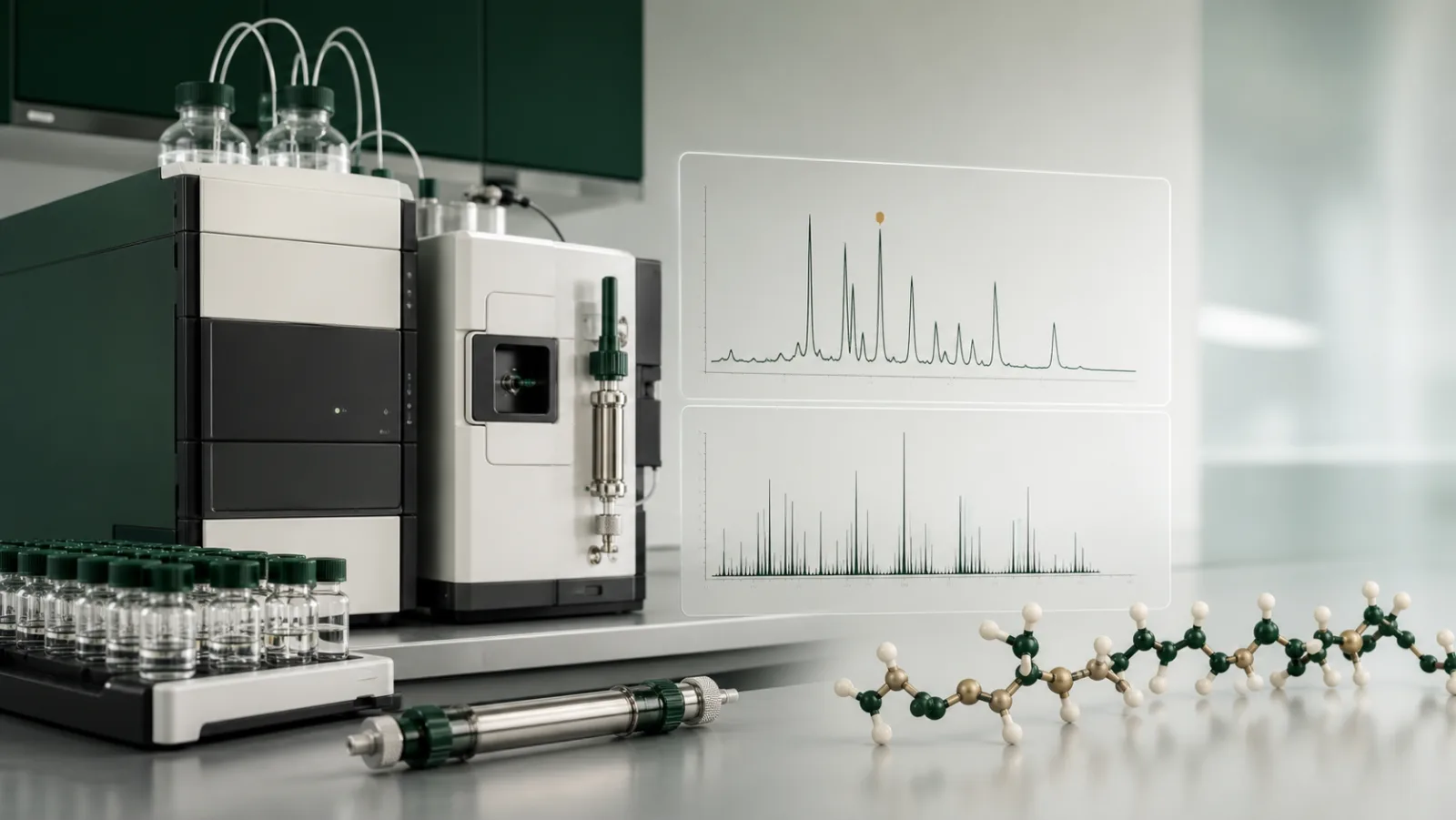
In reverse-phase high-performance liquid chromatography, a peptide sample is separated according to how its components interact with a stationary phase and a changing mobile phase. A detector records signal over time. Laboratories often divide the integrated area of the principal peak by the total integrated area of detected peaks and report the result as area percent purity. That value describes this separation, detector and integration method. It is not a direct mass balance of everything in the vial.
Components with weak absorbance at the selected wavelength may contribute little signal. Water, inorganic salts and many counter-ions may not appear as comparable peaks. Co-eluting impurities can hide under the principal peak. A reported 98 percent HPLC area therefore should not be read as 98 percent active peptide by vial mass.
Which method details change the result?
Column chemistry, particle size, temperature, mobile-phase modifier, gradient slope, flow rate and detection wavelength all affect selectivity and response. A shallow gradient may resolve closely related deletion or oxidation products that merge under a rapid screening gradient. Detection near 214 or 220 nanometres is sensitive to peptide bonds, while 280 nanometres mainly follows aromatic residues and can miss compounds that lack them.
Integration rules matter too. A baseline drawn differently can change the area assigned to a shoulder or broad impurity. A certificate should make the principal peak identifiable and disclose enough method information for a qualified analyst to understand the claim. Raw retention time alone does not establish identity unless it is compared under controlled conditions with a suitable reference.
How should a chromatogram be reviewed?
First match the sample name, lot and test date to the vial and certificate. Confirm that axes, wavelength and gradient are stated. Look for a principal peak that is on scale, a stable baseline and an integration table that accounts for minor peaks. Ask whether solvent blanks, system suitability or a reference were run. A visually clean trace without a lot identifier has little chain-of-custody value.
For method transfer or release work, acceptance criteria should be defined before looking at the result. ICH Q2(R2) organizes performance characteristics such as specificity, precision, accuracy and range. The exact validation burden depends on intended use, but a number becomes more credible when the procedure is demonstrated to be fit for that purpose.
What evidence should accompany HPLC?
Mass spectrometry supports molecular identity. Peptide content or amino-acid analysis can support quantitative mass assignment. Karl Fischer or another justified procedure can address water, and ion chromatography or a specific assay can quantify a counter-ion. For peptides susceptible to oxidation, deamidation or disulfide scrambling, orthogonal or stability-indicating methods may be needed.
The strongest certificate does not collapse these questions into one purity percentage. It states each test, result and method basis separately. That lets a laboratory decide whether the material is suitable for qualitative receptor screening, a quantitative standard or a more demanding biological experiment.
What is the most defensible conclusion?
A chromatogram can show that one detected component dominates under the reported conditions and can reveal resolved impurities. It cannot, by itself, prove sequence, sterility, absence of endotoxin, net peptide content or suitability for an experiment. Report the method and the limit of the inference together. That small discipline prevents a useful analytical result from becoming an unsupported quality promise.
Continue through the evidence
Methods and quality. LC-MS for Peptide Identity: Molecular Mass, Charge States and Sequence Evidence, Peptide Content Versus Purity: Why Net Mass Changes Quantitative Experiments, How to Read a Peptide Certificate of Analysis, Endotoxin and Bioburden in Peptide Research: Matching Tests to the Model, Peptide Counter-Ions: TFA, Acetate and Their Experimental Consequences, Peptide Disulfide Bonds, Oxidation and Analytical Confirmation, Peptide Reference Standards and System Suitability, GLP-1 Receptor Assay Design: Controls, Curves and Interpretation and Why Your Peptide Assay Disagrees: Purity, Counter-Ions and Reproducibility.
Connected peptide briefings. Research Peptides in Canada: A Laboratory Procurement Guide, Health Canada, Peptides and Research Use Only: What the 2026 Guidance Means and Shipping and Storing Research Peptides Across Canada.
Sources and further literature
- ICH Q2(R2): Validation of Analytical ProceduresInternational framework for analytical procedure validation.
- USP: Reference standards to support quality of synthetic peptide therapeuticsReview of identity, purity, content, counter-ion and strength testing.
- FDA: Analytical Procedures and Methods Validation for Drugs and BiologicsOfficial guidance on method development, validation and lifecycle management.
North Specs separates scientific education from product claims. Review primary literature, current regulations and institutional requirements before designing laboratory work.