Direct answer
A focused review of retatrutide as a GIP, GLP-1 and glucagon receptor agonist, from phase 1b and phase 2 trials to structural biology.
- Retatrutide is an investigational single peptide designed to activate GIP, GLP-1 and glucagon receptors.
- Phase 2 results are important but do not equal market authorization or establish every long-term outcome.
- Structural and matched functional assays are needed to understand receptor balance and mechanism.
What is retatrutide?
Retatrutide, also known during development as LY3437943, is an acylated peptide with agonist activity at GIPR, GLP-1R and GCGR. The design extends a long research programme in unimolecular co-agonists and triagonists. Its scientific premise is that a controlled balance of three receptor activities may produce a different integrated metabolic response from one or two receptors alone.
Triple agonist does not mean equal potency at all three receptors. The balance is a property measured under specified conditions, and it can change with assay system. Researchers should avoid reducing the molecule to a three-label slogan.
What did the early clinical studies find?
A phase 1b multiple-ascending-dose trial evaluated LY3437943 in people with type 2 diabetes and reported pharmacodynamic and safety observations. The 2023 phase 2 obesity trial randomized 338 adults and evaluated several dose and starting-dose groups over 48 weeks. It reported dose-related changes in body weight and gastrointestinal events, along with dose-dependent heart-rate increases that peaked earlier in the study.
The trial was designed to estimate dose-response relationships and inform later development. It was not a head-to-head comparison with semaglutide or tirzepatide, and its sample size and duration cannot answer every rare or long-term safety question.
What does structural biology add?
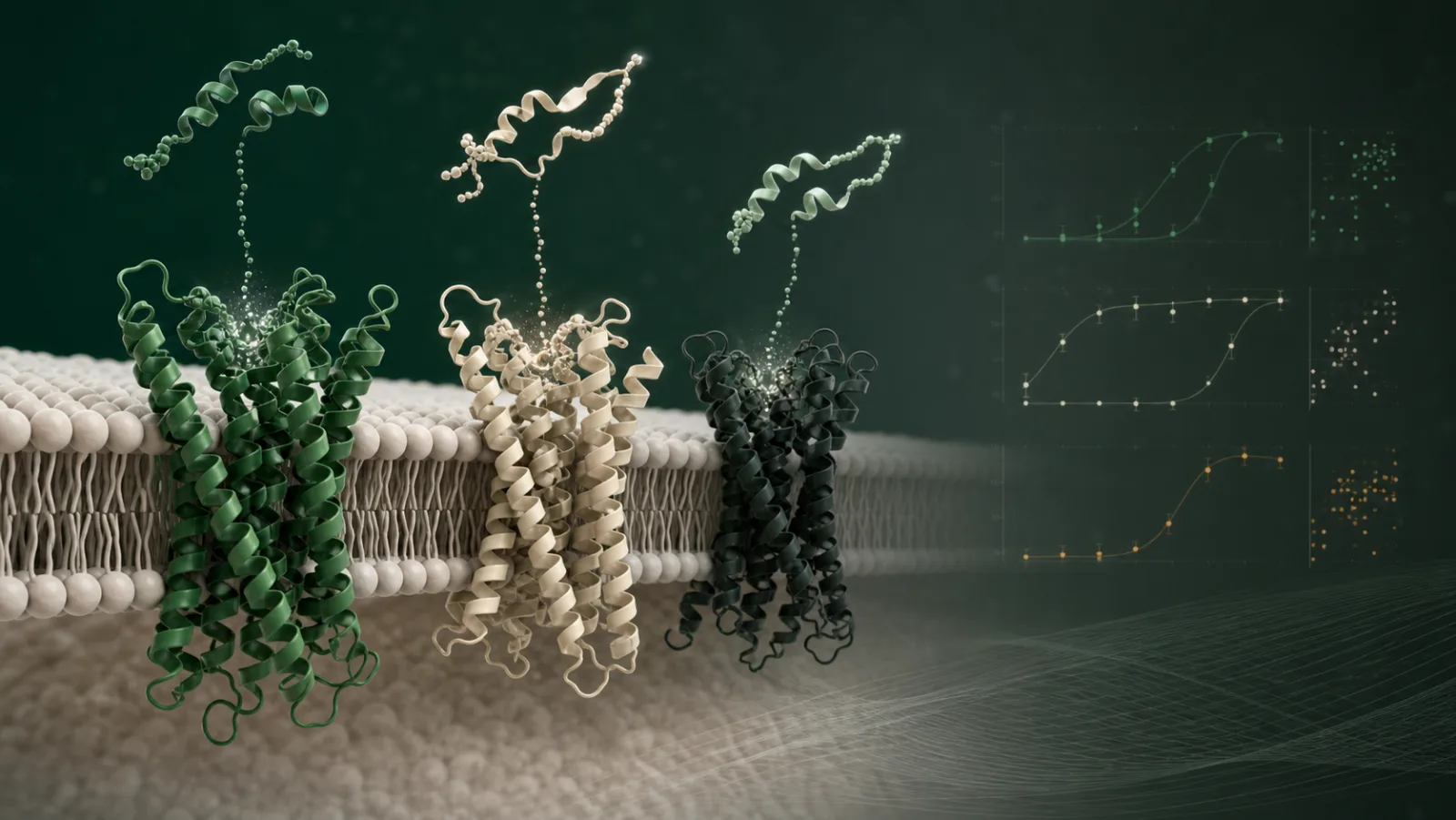
Cryo-electron microscopy and functional studies can show how retatrutide engages the extracellular and transmembrane regions of each receptor. Structural comparisons with endogenous ligands and other analogues help explain how one sequence tolerates three related receptor pockets. They do not by themselves predict a whole-organism outcome.
Structure should be paired with matched concentration-response data. Receptor expression, G-protein complement and readout amplification influence observed potency. A high-resolution image is a mechanistic model, not a substitute for functional replication.
How should laboratory retatrutide studies be controlled?
Use independent reference agonists for GIPR, GLP-1R and GCGR. Confirm that the same retatrutide lot is tested across receptors, and preserve the albumin and plastic conditions because acylated peptides can partition differently. Include vehicle, no-receptor or parental-cell controls and counterscreens where selectivity matters.
Report both potency and maximal response, with uncertainty. If a result depends on long incubation, test whether receptor internalization or degradation contributes. Confirm material identity and content so a shifted curve is not attributed to receptor biology prematurely.
Is retatrutide approved in Canada?
Retatrutide remains an investigational compound in the evidence reviewed here. A laboratory product listing must not be interpreted as Health Canada or FDA authorization. Canadian researchers and the public should use official regulatory databases to check current status, and unauthorized research material must not be used as a medicine.
Continue through the evidence
Methods and quality. Glucagon Receptor Experiments in Triple-Agonist Research, How to Read a Peptide Certificate of Analysis, HPLC Peptide Purity: How to Read a Chromatogram Without Overclaiming and LC-MS for Peptide Identity: Molecular Mass, Charge States and Sequence Evidence.
Connected peptide briefings. Incretin Research: GLP-1, GIP and the Move to Multi-Receptor Agonists, Tirzepatide and Dual GIP/GLP-1 Receptor Agonism, Retatrutide, Tirzepatide and Semaglutide: How to Compare the Research, Research Peptides in Canada: A Laboratory Procurement Guide, Health Canada, Peptides and Research Use Only: What the 2026 Guidance Means, Shipping and Storing Research Peptides Across Canada, GIP Receptor Pharmacology: Why the Experimental Context Matters and Semaglutide: From Peptide Engineering to FDA and Health Canada Milestones.
Sources and further literature
- LY3437943 triple-agonist phase 1b trialMultiple-ascending-dose trial, The Lancet, 2022.
- Retatrutide for obesity: Phase 2 trialRandomized phase 2 trial, New England Journal of Medicine, 2023.
- Structural insights into retatrutide triple agonismCryo-EM and receptor-structure study, 2024.
- A rationally designed monomeric peptide triagonist in rodent modelsFoundational preclinical triagonist paper, Nature Medicine, 2015.
North Specs separates scientific education from product claims. Review primary literature, current regulations and institutional requirements before designing laboratory work.