Direct answer
A research map for Vancouver and British Columbia, from peptide transport and membrane-protein methods to responsible laboratory procurement.
- Vancouver peptide science spans immunology, membrane proteins, transport biology, proteomics and biotechnology.
- Local relevance comes from research capabilities and institutional practice, not from changing the molecular evidence by city.
- British Columbia laboratories should apply the same lot documentation and intended-use controls used elsewhere in Canada.
Where does peptide research fit in Vancouver science?
Vancouver has a dense life-science network anchored by the University of British Columbia, teaching hospitals, core facilities and biotechnology companies. Peptides appear across that network as signalling molecules, antigens, transport sequences, analytical targets and engineered research tools. The field is broader than any one high-profile compound, which makes method selection and biological context more important than catalogue familiarity.
UBC examples show that range. Work associated with antigen processing asks how peptides are transported and presented to immune receptors. The Peptidisc platform uses an amphipathic peptide scaffold to stabilize membrane proteins in aqueous solution. Other groups investigate peptide-enabled transport across biological barriers. These programmes illustrate why a useful regional guide should point to methods and institutions, not make clinical promises.
Which analytical capabilities matter most?
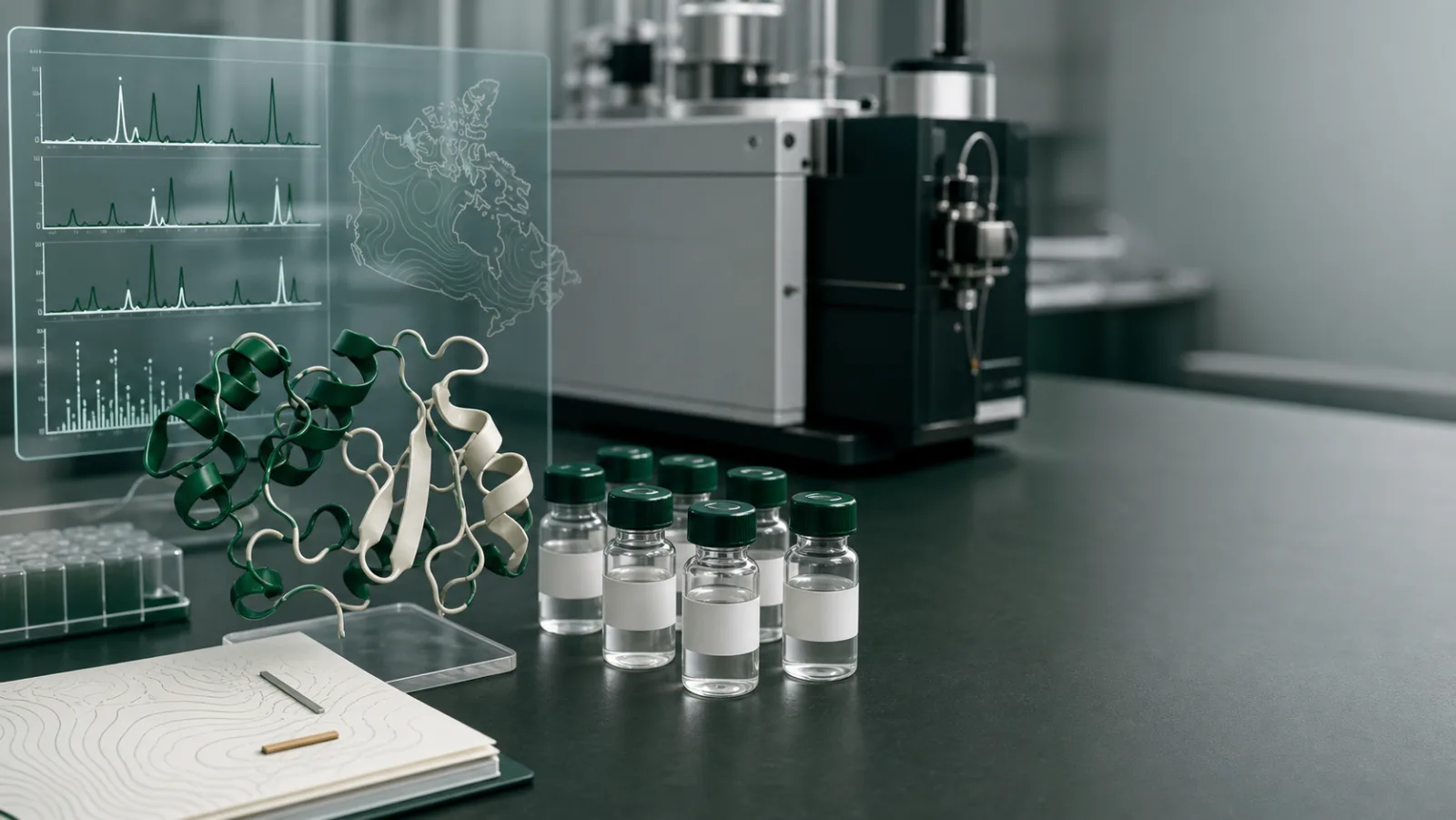
Peptide projects often need a combination of reverse-phase chromatography, intact-mass measurement, tandem mass spectrometry, cell-based readouts and bioinformatics. A core facility may confirm molecular mass or characterize a peptide-protein interaction, while the project laboratory controls sample history and biological endpoints. Clarify the question before choosing the instrument.
For an identity check, intact LC-MS may be sufficient. For sequence confirmation or impurity localization, fragmentation data may be needed. For a receptor study, the analytical material must be connected to functional controls and a concentration basis. Regional access to excellent instruments cannot correct an ambiguous sample record.
How should Vancouver laboratories source research peptides?
Sourcing should follow institutional rules for vendor approval, receiving, inventory and disposal. Ask for a lot-specific certificate and verify that the label, sequence and ordered form agree. If the work depends on absolute molarity, distinguish chromatographic purity from net peptide content. If cells or immune readouts are sensitive to contamination, assess whether endotoxin testing is required.
Canada-wide federal requirements still apply in British Columbia. A local address or rapid shipping does not change the regulatory status of an unauthorized health product. Research materials should remain within a genuine laboratory workflow, and public communications should not imply that a reagent is a treatment product.
What does local shipping change?
Shipping time influences exposure to temperature excursions and repeated handling. It does not determine stability by itself. Lyophilized and reconstituted forms can behave differently, and each sequence has its own solubility and degradation risks. Preserve arrival condition, package integrity and the time the material entered controlled storage.
Vancouver laboratories near a supplier may reduce transit complexity, but they still need chain of custody. A same-day parcel with no matching lot certificate is weaker evidence than a longer shipment with complete records and a verified receiving condition.
How can researchers use this regional map?
Use it to identify relevant facilities, collaborators and methods, then build a protocol around the scientific question. Consult institutional biosafety and ethics resources early. When procuring material, document why the selected grade and test package are suitable. The goal is a reproducible experiment that another Vancouver, Canadian or international laboratory could understand and repeat.
Continue through the evidence
Methods and quality. LC-MS for Peptide Identity: Molecular Mass, Charge States and Sequence Evidence, How to Read a Peptide Certificate of Analysis and HPLC Peptide Purity: How to Read a Chromatogram Without Overclaiming.
Canadian research context. The Peptide Research Landscape in Canada, Research Peptides in Brandon, MB: A Laboratory Guide, Research Peptides in Charlottetown, PE: A Laboratory Guide, Research Peptides in Gatineau, QC: A Laboratory Guide, Research Peptides in Lethbridge, AB: A Laboratory Guide and Research Peptides in Moncton, NB: A Laboratory Guide.
Connected peptide briefings. Research Peptides in Canada: A Laboratory Procurement Guide, Health Canada, Peptides and Research Use Only: What the 2026 Guidance Means and Shipping and Storing Research Peptides Across Canada.
Sources and further literature
- UBC Centre for Blood Research: Wilfred Jefferies research profilePeptide transport, antigen processing and blood-brain-barrier research context.
- UBC Biochemistry: Franck Duong and the Peptidisc platformMembrane-protein stabilization using an amphipathic peptide scaffold.
- Health Canada: Think twice before injecting peptides bought onlineFederal public advisory, April 2026.
North Specs separates scientific education from product claims. Review primary literature, current regulations and institutional requirements before designing laboratory work.