Thymosin beta-4 is unusual among tissue-repair peptides in having a well-defined molecular function that was established before its regenerative properties were of interest. It is the major actin-sequestering protein in most mammalian cells. That mechanistic grounding gives the research base a firmer footing than most of the field.
This article summarises published research. All products supplied by North Specs Labs are Research Use Only and are not for human or veterinary use.
Molecular identity and function
Thymosin beta-4 is a 43-amino-acid peptide present at high intracellular concentration in most cell types. Its primary function is binding monomeric G-actin, holding a reservoir of actin subunits available for polymerisation into filamentous F-actin.
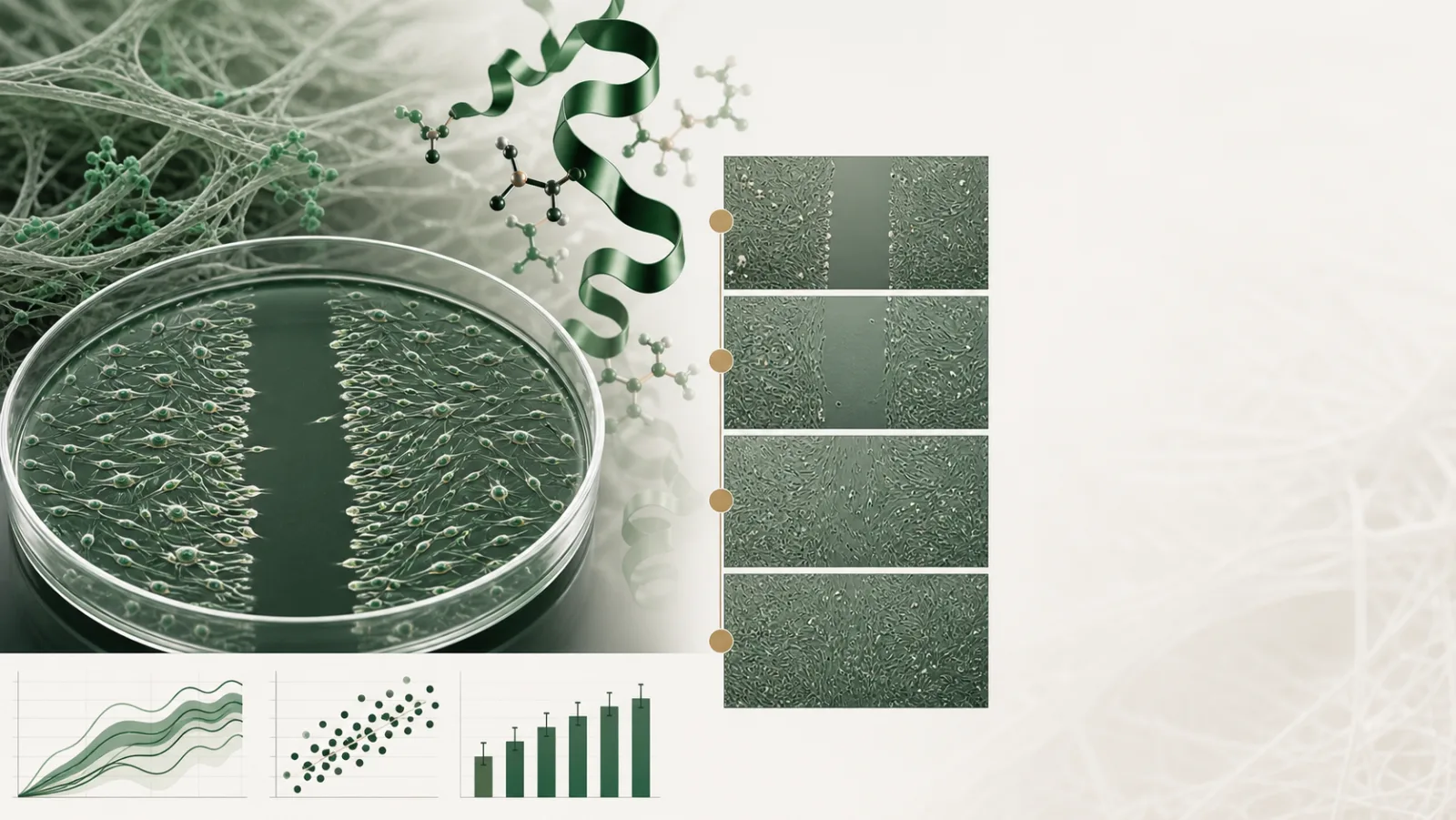
This matters because cell migration depends on regulated actin polymerisation at the leading edge. Any process requiring cells to move into a wound, endothelial cells forming new vessels, keratinocytes closing an epidermal defect, stem cells migrating to injured myocardium, depends on the actin machinery that thymosin beta-4 regulates.
That connection between a specific biochemical function and a broad regenerative role is the reason the peptide has been studied across so many tissue types without the mechanism appearing arbitrary.
TB-500 and the naming question
TB-500 and thymosin beta-4 are commonly treated as interchangeable, which is not quite right and is worth being precise about.
Thymosin beta-4 is the full 43-residue peptide. TB-500, as generally supplied and studied, refers to a shorter fragment corresponding to the actin-binding region, most often the sequence around residues 17 to 23 containing the LKKTET motif that mediates actin binding.
The rationale for the fragment is that the actin-binding motif carries much of the relevant activity at lower synthesis cost, with better solubility and stability. Whether the fragment fully reproduces the parent peptide's activity is not settled. Thymosin beta-4 has functions beyond actin sequestration, including reported anti-inflammatory effects and interactions that may not depend solely on the LKKTET region.
For experimental work this distinction matters directly. Results obtained with the full-length peptide should not be assumed to transfer to the fragment, and vice versa. Check what a supplier is actually providing, and record which was used.
The research base
Cardiac. Work in myocardial infarction models reports improved cardiac function and reduced scar formation, with proposed mechanisms including epicardial progenitor cell activation and promotion of new vessel formation. This is among the better-developed lines of investigation.
Corneal and ocular. Thymosin beta-4 has been examined in human clinical trials for corneal surface disorders including dry eye and neurotrophic keratopathy. This represents some of the strongest human data for any peptide in the tissue-repair category.
Dermal wound healing. Animal and human work reports accelerated closure in dermal wounds, including in impaired-healing models such as diabetic and steroid-treated animals.
Neurological. Studies in traumatic brain injury and stroke models report improved functional recovery, with proposed mechanisms involving oligodendrogenesis and neurovascular remodelling.
Anti-fibrotic. Several lines report reduced fibrosis, which is mechanistically interesting because it separates thymosin beta-4 from growth factors that accelerate healing at the cost of increased scarring.
Why the evidence profile differs from BPC-157
It is worth stating the contrast directly, because the two peptides are often discussed together.
Thymosin beta-4 has an identified molecular target and a mechanism that was characterised independently of any therapeutic interest. It has been studied by a genuinely diverse set of research groups across multiple countries. It has progressed to registered human clinical trials in defined indications. And its actions are consistent with a single coherent mechanism rather than requiring a separate explanation for each tissue.
None of this makes it a proven therapy. Clinical development has not produced broad approval, and several programmes have not advanced. But the evidence base is structurally sounder, and a researcher choosing between the two for mechanistic work has a clearer path with thymosin beta-4.
Laboratory handling
Both the full-length peptide and the fragment are supplied lyophilised. Standard research peptide practice applies: sealed, dry, dark, frozen storage; room-temperature equilibration before opening; reconstitution with diluent added down the vial wall; gentle swirling rather than shaking.
Thymosin beta-4 is highly soluble in aqueous buffer, which makes reconstitution straightforward. The sequence contains a methionine, so oxidation is a consideration; protection from light and air, and avoidance of prolonged storage in solution, are worthwhile precautions. Oxidised methionine is detectable by mass spectrometry as a mass shift, and is worth checking if activity appears to decline in stored material.
For cell-based assays, residual trifluoroacetate from purification is a common confounder. If a viability or migration assay shows unexpected effects at higher concentrations, counter-ion content is a more likely explanation than a genuine biphasic response, and the certificate of analysis should report it.
Designing work in this area
The most useful contributions in this space tend to be those that resolve existing ambiguity rather than adding another positive result in a new tissue.
Direct comparison of full-length thymosin beta-4 against the LKKTET fragment in the same model, with the same batch quality, would settle a question that is currently assumed rather than demonstrated. Dose-response characterisation, rather than single-dose demonstration, would clarify whether effects are graded as a receptor-mediated mechanism would predict. And separating actin-dependent from actin-independent effects, using actin-binding-deficient variants, would test whether the proposed mechanism is actually the operative one.
North Specs Labs supplies research-grade peptides to qualified researchers, laboratories and research institutions. All products are Research Use Only and are not for human consumption or veterinary use.
Continue through the evidence
Methods and quality. Peptide Amidation, Acetylation and Other Terminal Modifications, How to Read a Peptide Certificate of Analysis, HPLC Peptide Purity: How to Read a Chromatogram Without Overclaiming and LC-MS for Peptide Identity: Molecular Mass, Charge States and Sequence Evidence.
Canadian research context. Peptide and Proteomics Research in Alberta.
Connected peptide briefings. TB-500 and Thymosin Beta-4: Why the Fragment Distinction Matters, BPC-157 Research: Evidence Gaps and Replication-First Study Design, Research Peptides in Canada: A Laboratory Procurement Guide, Health Canada, Peptides and Research Use Only: What the 2026 Guidance Means, Shipping and Storing Research Peptides Across Canada, GHK-Cu: Copper Peptide Research in Wound Healing and Skin Biology and BPC-157: What the Preclinical Literature Actually Shows.
Sources and further literature
- Thymosin beta-4 corneal wound studyFoundational preclinical study.
- Thymosin beta-4 tissue repair reviewPeer-reviewed review.
- Health Canada: Think twice before injecting peptides bought onlineApril 2026 warning on unauthorized peptide products.
North Specs separates scientific education from product claims. Review primary literature, current regulations and institutional requirements before designing laboratory work.