For most of the history of molecular biology, mitochondrial DNA was understood to encode thirteen proteins, all components of the respiratory chain. The discovery that additional short open reading frames within mitochondrial DNA encode functional peptides, and that some of these peptides appear to signal back to the nucleus, was genuinely unexpected.
The field is young enough that its central claims are still being tested. That makes it interesting to work in and easy to overstate.
All products supplied by North Specs Labs are Research Use Only and are not for human or veterinary use.
Humanin
Humanin was identified in a screen for factors protecting neurons against a form of amyloid-beta toxicity. It is a 24-amino-acid peptide encoded within the mitochondrial 16S ribosomal RNA gene.
The reported activities centre on cytoprotection. Humanin has been described as suppressing apoptosis through interaction with Bcl-2 family proteins, and as acting extracellularly through a receptor complex involving components identified as CNTFR, WSX-1 and gp130. Circulating humanin levels have been reported to decline with age in humans and to correlate with markers of metabolic health.
Analogues with substitutions intended to increase potency, including the widely used S14G variant, are common in laboratory work.
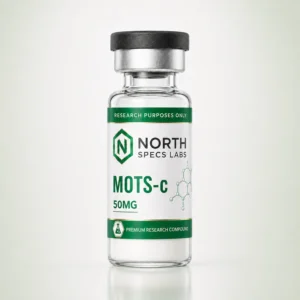
MOTS-c
MOTS-c, standing for mitochondrial open reading frame of the twelve S ribosomal RNA type-c, is a 16-amino-acid peptide encoded in the 12S rRNA region.
The reported biology is metabolic. MOTS-c has been described as activating AMP-activated protein kinase, a central energy sensor, and as influencing the folate-methionine cycle and purine biosynthesis. In mouse models, administration has been reported to improve insulin sensitivity and reduce diet-induced obesity, with effects on skeletal muscle metabolism.
A more striking claim is that MOTS-c translocates to the nucleus under metabolic stress and influences nuclear gene expression, which would make it a direct mitochondrial-to-nuclear signalling molecule rather than merely a circulating factor. This retrograde signalling hypothesis is the field's most consequential idea and also the one requiring the most careful validation.
Human genetic work has reported an association between a MOTS-c variant and exceptional longevity in a Japanese cohort, though as with all such associations, replication across populations matters.
SHLPs and the wider microprotein field
Six additional peptides identified from the same 16S rRNA region, designated small humanin-like peptides one through six, have reported activities ranging from metabolic effects to cytoprotection, with SHLP2 the most studied.
More broadly, the recognition that short open reading frames throughout both the nuclear and mitochondrial genomes encode functional microproteins has become a substantial field in its own right. Ribosome profiling has revealed far more translated short ORFs than the annotated proteome accounted for. Mitochondrial-derived peptides are one well-defined corner of that larger picture.
What is solid and what is not
Reasonably established: these peptides exist, are translated, and are detectable in circulation. They have measurable biochemical activities in cell and animal systems. Levels change with age and metabolic state in human cohorts.
Plausible but not settled: the receptor mechanisms. The humanin receptor complex is supported by more evidence than most, but the field lacks the clean pharmacological validation that a well-characterised receptor system would have. For MOTS-c, whether AMPK activation is direct or downstream of other events is not fully resolved.
Genuinely open: the physiological significance in humans. Demonstrating that a peptide has effects when administered at pharmacological concentrations is different from demonstrating that endogenous concentrations perform a physiological function. The retrograde signalling model is attractive and would be important if correct, but attractive models require more than supportive evidence to be accepted.
Not established at all: any therapeutic claim. No mitochondrial-derived peptide is approved anywhere for any use. Human intervention data is minimal.
Working with these peptides
They are short, which makes synthesis straightforward and purity verification uncomplicated relative to long acylated analogues.
Solubility. Humanin and its analogues can be awkward in aqueous buffer, and the hydrophobic character of parts of the sequence contributes to aggregation. Check the batch guidance rather than assuming a standard reconstitution will work.
Oxidation. Both humanin and MOTS-c sequences contain methionine, so oxidation is a real consideration. Protect from light and air, avoid extended storage in solution, and check for the characteristic mass shift by MS if activity declines in stored material.
Aggregation. Short peptides with hydrophobic stretches aggregate, and aggregates behave differently in assays than monomeric peptide. Gentle handling at reconstitution, avoidance of shaking, and single-use aliquoting all reduce the problem.
Analogue versus native. Much published work uses the S14G humanin analogue rather than native humanin. Results are not interchangeable, and the specific variant should be recorded.
Where the useful work is
The field would benefit most from things it currently lacks: rigorous receptor identification and validation, independent replication of the retrograde signalling observations by groups without a stake in the model, careful dose-response work establishing whether effects occur at physiologically plausible concentrations, and loss-of-function experiments that are genuinely interpretable given the difficulty of knocking out a sequence embedded within an essential rRNA gene.
That last problem is the field's hardest methodological constraint and worth understanding before designing experiments: these peptides are encoded inside genes that cells cannot do without, which makes conventional genetic approaches to establishing necessity very difficult.
North Specs Labs supplies research-grade peptides to qualified researchers, laboratories and research institutions. All products are Research Use Only and are not for human consumption or veterinary use.
Continue through the evidence
Methods and quality. Peptide Experimental Controls: Vehicle, Scrambled Sequence and Reference Ligands, How to Read a Peptide Certificate of Analysis, HPLC Peptide Purity: How to Read a Chromatogram Without Overclaiming, LC-MS for Peptide Identity: Molecular Mass, Charge States and Sequence Evidence and Endotoxin and Bioburden in Peptide Research: Matching Tests to the Model.
Canadian research context. Peptide and Proteomics Research in Alberta.
Connected peptide briefings. MOTS-c Research: Mitochondrial Peptide Assays and Model Selection, Low-Binding Tubes and Peptide Adsorption: Preventing Invisible Sample Loss, Research Peptides in Canada: A Laboratory Procurement Guide, Health Canada, Peptides and Research Use Only: What the 2026 Guidance Means, Shipping and Storing Research Peptides Across Canada and Epithalon and the Peptide Bioregulator Tradition.
Sources and further literature
- Foundational MOTS-c discovery report2015 mitochondrial peptide study.
- PubMed mitochondrial-derived peptide literatureLive indexed literature search.
- Health Canada: Think twice before injecting peptides bought onlineApril 2026 warning on unauthorized peptide products.
North Specs separates scientific education from product claims. Review primary literature, current regulations and institutional requirements before designing laboratory work.