GHK-Cu is unusual among research peptides in that its defining property is inorganic. The tripeptide glycyl-L-histidyl-L-lysine binds copper(II) with high affinity, and much of its biology follows from that coordination chemistry rather than from receptor binding in the conventional sense.
All products supplied by North Specs Labs are Research Use Only and are not for human or veterinary use.
Identity and origin
GHK was identified in human plasma during work on factors that caused aged liver tissue to behave more like young tissue in culture. The active component turned out to be a tripeptide, and its activity depended on copper.
The peptide occurs naturally in human plasma, with reported concentrations declining substantially with age, from roughly 200 nanograms per millilitre in young adults to appreciably lower levels in later decades. It is also found in saliva and urine. It is thought to be released from larger proteins, including collagen, during tissue injury, which would position it as an endogenous signal of damage.
The copper chemistry
The histidine imidazole nitrogen, the terminal amine and backbone nitrogens coordinate copper(II) in a square-planar geometry with very high affinity. This is the central fact about the molecule.
The complex is thought to act partly as a copper delivery vehicle. Copper is essential for several enzymes central to connective tissue, notably lysyl oxidase, which cross-links collagen and elastin, and superoxide dismutase. Free copper is toxic and is therefore tightly chaperoned in biology. A peptide that binds copper with appropriate affinity can plausibly deliver it to where it is needed without the toxicity of free ion.
This has a direct practical consequence: GHK and GHK-Cu are not interchangeable. Supplying the apo-peptide without copper, or supplying the complex, are different experiments. The literature is not always careful about which was used, and researchers should be.
Reported biology
Collagen and extracellular matrix. Reported stimulation of collagen synthesis by dermal fibroblasts, along with effects on elastin, glycosaminoglycans and proteoglycans. Also reported effects on matrix metalloproteinases and their tissue inhibitors, suggesting influence over matrix remodelling rather than synthesis alone.
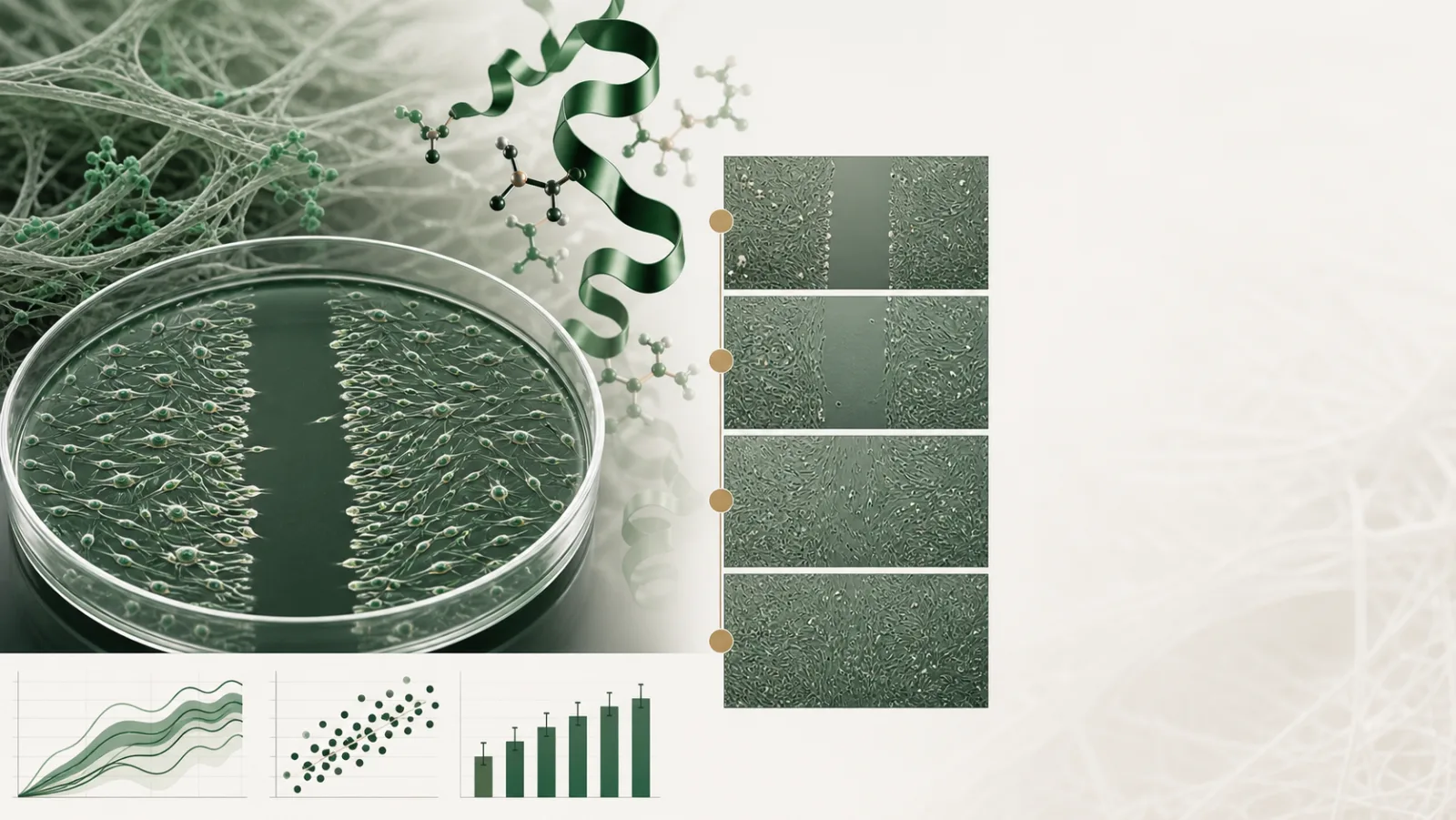
Wound healing. Animal models report accelerated closure and improved tissue quality.
Angiogenesis. Reported promotion of new vessel formation, consistent with effects on VEGF.
Antioxidant and anti-inflammatory effects. Reported suppression of inflammatory signalling and modulation of oxidative stress, partly attributable to the copper's role in superoxide dismutase.
Gene expression. Broad transcriptomic analyses have reported that GHK modulates expression of a large number of genes, with the pattern described as shifting cells toward a more youthful or regenerative profile. Such broad expression analyses are hypothesis-generating and should be read as such rather than as demonstrations of specific mechanism.
Hair follicle effects. A separate line reports effects on hair follicle size and growth.
Evidence quality
The evidence base is better than much of the tissue-repair peptide field for two reasons. The mechanism has a real chemical foundation, copper coordination is measurable and the downstream enzymology is established independently. And the peptide has been studied by a genuinely varied set of groups, including substantial work in cosmetic science where it has been used commercially for years.
Limitations remain. Much of the strongest data concerns topical application to skin, where the peptide is applied directly to the target tissue at high local concentration. Systemic effects are less well characterised. And the very breadth of reported gene expression changes, while interesting, makes it hard to attribute any particular outcome to a specific pathway.
Regulatory position: GHK-Cu is used in cosmetic formulation in many jurisdictions under cosmetic rather than drug regulation. It is not approved as a therapeutic agent.
Laboratory handling
GHK-Cu has handling characteristics that differ from ordinary peptides, and getting them wrong is a common source of confusing results.
The copper is the point. Verify whether you have the apo-peptide or the copper complex. The complex is typically a distinctive blue, a useful visual check. A colourless preparation sold as GHK-Cu warrants a question.
Chelators destroy the experiment. Buffers containing EDTA or other chelating agents will strip copper from the complex. This is the single most common handling error with this compound. Check buffer composition before assuming an assay result reflects peptide activity.
pH sensitivity. Copper coordination is pH-dependent. Working outside the intended range alters the species present in solution.
Light and oxidation. Copper complexes can participate in redox chemistry. Protect from light, avoid prolonged storage in solution, and be aware that copper in the presence of reducing agents can generate reactive oxygen species, which may confound assays sensitive to oxidative stress.
Histidine. The sequence contains histidine, which can be susceptible to modification under some conditions.
Standard practice otherwise applies: sealed, dry, dark, frozen storage of the lyophilised material; room-temperature equilibration before opening; gentle reconstitution; single-use aliquots.
Designing useful work
The most informative experiments in this area tend to separate the copper from the peptide. Comparing GHK-Cu against apo-GHK, against copper salt alone at matched concentration, and against a copper-loaded control chelator distinguishes whether an observed effect reflects the intact complex, copper delivery generally, or the peptide independent of metal. A surprising amount of published work omits at least one of those controls, and the resulting ambiguity is avoidable.
North Specs Labs supplies research-grade peptides to qualified researchers, laboratories and research institutions. All products are Research Use Only and are not for human consumption or veterinary use.
Continue through the evidence
Methods and quality. Peptide Counter-Ions: TFA, Acetate and Their Experimental Consequences, Peptide Experimental Controls: Vehicle, Scrambled Sequence and Reference Ligands, How to Read a Peptide Certificate of Analysis, HPLC Peptide Purity: How to Read a Chromatogram Without Overclaiming and LC-MS for Peptide Identity: Molecular Mass, Charge States and Sequence Evidence.
Canadian research context. Peptide and Proteomics Research in Alberta and Research Peptides in St. John’s, NL: A Laboratory Guide.
Connected peptide briefings. GHK-Cu Research: Copper Coordination and Experimental Design, Research Peptides in Canada: A Laboratory Procurement Guide, Health Canada, Peptides and Research Use Only: What the 2026 Guidance Means, Shipping and Storing Research Peptides Across Canada and TB-500 and Thymosin Beta-4: Actin Dynamics in Tissue Repair Research.
Sources and further literature
- GHK-Cu human fibroblast studyPrimary cell-culture research.
- Recent GHK-Cu research recordContemporary primary literature.
- Health Canada: Think twice before injecting peptides bought onlineApril 2026 warning on unauthorized peptide products.
North Specs separates scientific education from product claims. Review primary literature, current regulations and institutional requirements before designing laboratory work.