Compounds that raise growth hormone are frequently grouped together as though they were variations on a theme. They are not. Two separate receptor systems are involved, they behave differently, and conflating them produces uninterpretable experiments.
All products supplied by North Specs Labs are Research Use Only and are not for human or veterinary use.
The axis
Growth hormone is released from somatotroph cells of the anterior pituitary in a pulsatile pattern under dual control. Growth hormone releasing hormone from the hypothalamus stimulates release. Somatostatin inhibits it. The interplay of these two produces the characteristic pulses, and much of GH biology depends on that pulsatility rather than on total output.
A third input was identified later. Ghrelin, produced mainly in the stomach, acts on the growth hormone secretagogue receptor and also stimulates GH release, through a distinct pathway.
Downstream, GH acts partly directly and partly through insulin-like growth factor 1, produced mainly in the liver. IGF-1 mediates many of GH's anabolic effects and exerts negative feedback on the axis.
Class one: GHRH analogues
These act at the GHRH receptor on somatotrophs, the same receptor the endogenous hypothalamic peptide uses.
Sermorelin corresponds to the first 29 residues of human GHRH, the minimum fragment retaining full activity. Its half-life is short, minutes rather than hours.
Tesamorelin is a stabilised GHRH analogue with a modification conferring resistance to DPP-4 cleavage. It has completed registered clinical development for a specific indication, giving it more human data than most compounds in this space.
CJC-1295 exists in two forms that are frequently confused. The modified GHRH analogue with a reactive linker enabling covalent albumin binding has a greatly extended half-life; this is the form correctly designated with DAC, for drug affinity complex. Without that linker, the compound is essentially a tetrasubstituted GHRH fragment with a much shorter duration. These are not the same molecule and do not behave the same way. Confirm which you have.
The defining property of this class is that it works through the physiological pathway. Because somatostatin still opposes it, the axis retains its negative feedback and its pulsatile character. GH output rises, but regulation is preserved.
Class two: ghrelin mimetics
These act at the growth hormone secretagogue receptor, GHSR-1a.
Ipamorelin is a pentapeptide notable for selectivity. It stimulates GH release with minimal effect on cortisol, prolactin or appetite, which is unusual in this class and makes it a cleaner experimental tool when the aim is to probe GH release specifically.
Hexarelin is a hexapeptide with higher potency but less selectivity, with reported effects on cortisol and prolactin, and reported desensitisation with sustained exposure.
GHRP-2 and GHRP-6 are earlier compounds in this family. GHRP-6 in particular has pronounced appetite-stimulating effects through the ghrelin pathway, which is a confounder in metabolic studies and useful if appetite is the subject.
The ghrelin system carries functions beyond GH release, including appetite regulation, gastric motility and effects on reward circuitry. Compounds acting here engage those functions to varying degrees, and selectivity across them is the main axis on which these compounds differ.
Why the distinction matters experimentally
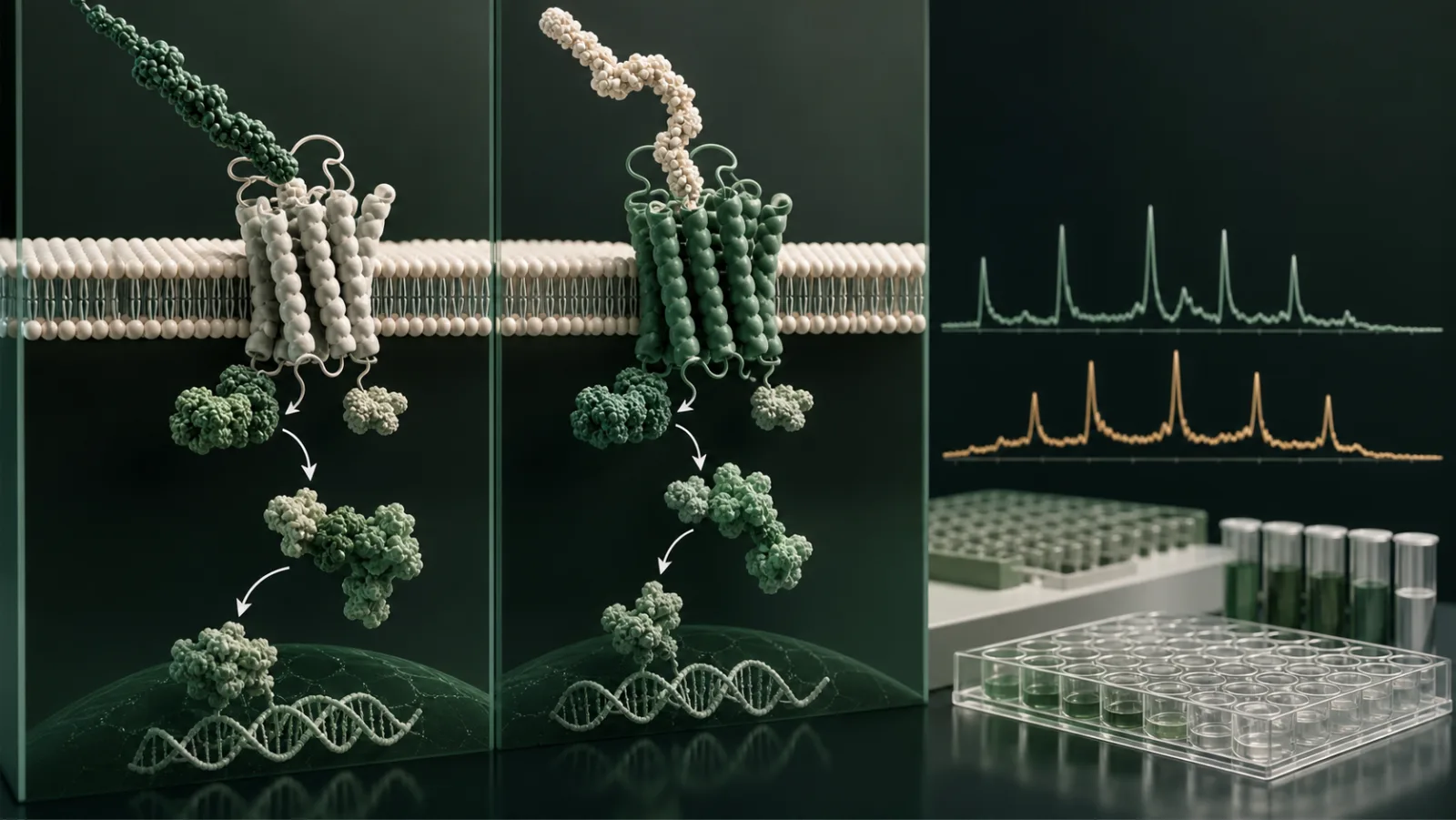
Different receptors mean different controls. A GHRH receptor antagonist will block the first class and not the second. Designing a mechanism experiment requires knowing which receptor is in play.
Additivity. Because the two classes act through separate receptors, combined administration produces a greater GH response than either alone. This is a genuine pharmacological interaction and is one reason the two are often studied together.
Feedback differs. GHRH analogues operate within somatostatin's restraint. Ghrelin mimetics partly bypass it. Predictions about sustained exposure differ accordingly.
Off-target profiles differ. Cortisol and prolactin effects in the ghrelin-mimetic class are a real confounder for any endpoint sensitive to those hormones. Selectivity data should inform compound choice.
Desensitisation. Sustained receptor agonism can produce downregulation. This is more documented for some compounds than others and should be considered in chronic-exposure designs.
Regulatory and anti-doping position
Tesamorelin has regulatory approval in some jurisdictions for a defined indication. Sermorelin has had approvals historically. Most other compounds in both classes have no therapeutic approval.
The World Anti-Doping Agency prohibits growth hormone secretagogues, GHRH analogues and GH-releasing peptides. This applies across both classes and is independent of any national drug regulatory status.
Laboratory handling
These are mostly short peptides, straightforward to synthesise and characterise.
Ipamorelin, hexarelin and the GHRPs are short and generally water-soluble. The GHRH analogues are longer, 29 residues or more, and sermorelin in particular is known to be relatively unstable in solution; it should not be stored reconstituted for extended periods.
CJC-1295 with DAC carries a maleimide-based linker designed to react with albumin. That reactive group is chemistry, and its integrity depends on handling. Material that has been poorly stored may have a hydrolysed or otherwise compromised linker, giving a peptide that no longer binds albumin and therefore behaves like the short-duration form. This failure mode is invisible without analysis and is a plausible explanation when a DAC compound behaves unexpectedly.
Standard practice applies throughout: sealed, dry, dark, frozen storage; equilibration before opening; gentle reconstitution down the vial wall; single-use aliquots; batch-specific certificates as the basis for any purity assumption.
Designing interpretable work
The most common design weakness in this area is treating GH output as the only endpoint. Because pulsatility carries biological meaning, a single timepoint measurement can miss the property that matters most. Frequent sampling to characterise pulse amplitude and frequency, rather than a single peak value, distinguishes a compound that amplifies physiological pulses from one that produces sustained elevation, and those are different pharmacologies with different downstream consequences.
North Specs Labs supplies research-grade peptides to qualified researchers, laboratories and research institutions. All products are Research Use Only and are not for human consumption or veterinary use.
Continue through the evidence
Methods and quality. How to Read a Peptide Certificate of Analysis, HPLC Peptide Purity: How to Read a Chromatogram Without Overclaiming, LC-MS for Peptide Identity: Molecular Mass, Charge States and Sequence Evidence, Peptide Content Versus Purity: Why Net Mass Changes Quantitative Experiments and Albumin Binding and Acylated Peptides: A Research Methods Guide.
Canadian research context. Research Peptides in Burnaby, BC: A Laboratory Guide.
Connected peptide briefings. CJC-1295 With DAC: Albumin Binding and Growth Hormone Axis Research, Ipamorelin and Hexarelin: Ghrelin Receptor Selectivity in Research, Sermorelin and Tesamorelin: Comparing GHRH Analogues in Research, Research Peptides in Canada: A Laboratory Procurement Guide, Health Canada, Peptides and Research Use Only: What the 2026 Guidance Means and Shipping and Storing Research Peptides Across Canada.
Sources and further literature
- CJC-1295 human pharmacology studyEarly compound-specific research.
- Ipamorelin receptor selectivity studyFoundational comparative pharmacology.
- Health Canada: Think twice before injecting peptides bought onlineApril 2026 warning on unauthorized peptide products.
North Specs separates scientific education from product claims. Review primary literature, current regulations and institutional requirements before designing laboratory work.