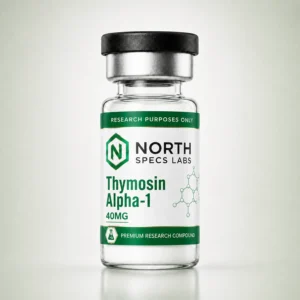
Thymosin alpha-1 has a longer and more conventional development history than most peptides in the research catalogue. It has been through clinical trials across several indications, holds regulatory approval in a number of countries, and has a mechanism grounded in identified receptor signalling.
All products supplied by North Specs Labs are Research Use Only and are not for human or veterinary use.
Identity
Thymosin alpha-1 is a 28-amino-acid peptide, acetylated at the N-terminus, originally isolated from thymosin fraction 5, a preparation from bovine thymus. The thymus is where T cells mature, and the working hypothesis from the outset was that thymic factors direct that maturation.
The peptide is derived from a larger precursor, prothymosin alpha, which has its own distinct intracellular functions. The relationship between the precursor's intracellular role and the fragment's extracellular signalling role is not fully resolved.
Mechanism
The best-supported mechanistic account centres on Toll-like receptor signalling, particularly TLR9 and TLR2, on dendritic cells. Engagement there influences dendritic cell maturation, which in turn shapes the T-cell response, biasing toward Th1 differentiation.
Reported downstream effects include increased T-cell maturation and output, enhanced natural killer cell activity, augmented interleukin-2 and interferon-gamma production, effects on regulatory T-cell populations, and increased expression of MHC class I molecules, which is relevant to recognition of infected or transformed cells.
The overall characterisation in the literature is of an immune modulator rather than a straightforward stimulant. Reports describe restoration of function in immunosuppressed states alongside dampening of excessive inflammatory responses, which is a more nuanced profile than simple activation and is correspondingly harder to demonstrate cleanly.
Clinical history
Thymosin alpha-1 has been studied across a wider range of clinical contexts than most peptides.
Chronic hepatitis B and C were the earliest major indications, with trials examining it alone and combined with interferon.
Oncology applications have been studied as an adjunct, particularly around chemotherapy-associated immunosuppression, with work in melanoma and non-small cell lung cancer among others.
Sepsis and critical illness have been examined on the rationale that immune dysfunction is central to outcome.
Vaccine adjuvant use has been explored in populations with poor vaccine response, including elderly and dialysis patients.
Regulatory status is genuinely fragmented. The peptide is approved in a number of countries, with China and several other jurisdictions among them, for defined indications. It is not approved in the United States, where it has held orphan drug designation for certain indications without full approval, nor in Canada. The European position varies by member state.
This fragmentation is itself informative. It generally indicates a compound with real but modest or context-dependent effects, where different regulators reviewing overlapping evidence reached different conclusions about sufficiency.
Evidence quality
Better than most of the research peptide field, with caveats.
The strengths are genuine: multiple randomised controlled trials exist, research has been conducted by varied groups internationally, and the mechanism connects to well-characterised immunology through identified receptors.
The limitations are equally real. Trial sizes have often been modest. Results across indications have been mixed rather than uniformly positive. Several meta-analyses have noted heterogeneity in study quality. And the immune-modulating mechanism, while plausible, makes clean demonstration difficult because the expected effect depends on the immune state of the subject, which varies.
Laboratory handling
N-terminal acetylation. This is a defining feature of the molecule, not an optional modification. Non-acetylated material is a different compound with different properties. Confirm from the certificate that the acetylated form was supplied; the mass difference is 42 daltons and should be evident in the mass spectrometry data.
Length and synthesis. At 28 residues the peptide is long enough that deletion sequences from incomplete coupling are a realistic concern. Purity verification matters more here than for a short peptide.
Solubility. Generally water-soluble.
Sequence liabilities. The sequence is relatively free of the most oxidation-prone residues, which simplifies storage relative to methionine- or tryptophan-containing peptides.
Standard practice applies: sealed, dry, dark, frozen storage of lyophilised material; equilibration before opening; gentle reconstitution with diluent down the vial wall; refrigerated single-use aliquots after reconstitution.
For immunological assays specifically, endotoxin is a critical consideration that is easy to overlook. Any endotoxin contamination will itself activate Toll-like receptor signalling, which is precisely the pathway under study. An endotoxin-driven artefact is indistinguishable from a genuine effect without appropriate controls, so endotoxin testing and a polymyxin B control are worth building into the design rather than adding after an ambiguous result.
North Specs Labs supplies research-grade peptides to qualified researchers, laboratories and research institutions. All products are Research Use Only and are not for human consumption or veterinary use.
Continue through the evidence
Methods and quality. Endotoxin and Bioburden in Peptide Research: Matching Tests to the Model, Peptide Experimental Controls: Vehicle, Scrambled Sequence and Reference Ligands, How to Read a Peptide Certificate of Analysis, HPLC Peptide Purity: How to Read a Chromatogram Without Overclaiming, LC-MS for Peptide Identity: Molecular Mass, Charge States and Sequence Evidence and Peptide Disulfide Bonds, Oxidation and Analytical Confirmation.
Canadian research context. Peptide Research in Manitoba: A Laboratory Methods Guide.
Connected peptide briefings. Thymosin Alpha-1 and COVID-19: A 2020 Historical Evidence Review, Research Peptides in Canada: A Laboratory Procurement Guide, Health Canada, Peptides and Research Use Only: What the 2026 Guidance Means, Shipping and Storing Research Peptides Across Canada and Melanocortin Peptides: Receptor Subtypes, Selectivity and the PT-141 Story.
Sources and further literature
- Thymosin alpha-1 COVID-19 retrospective cohortObservational study requiring cautious interpretation.
- Additional thymosin alpha-1 COVID-19 retrospective studyPeer-reviewed observational literature.
- Health Canada: Think twice before injecting peptides bought onlineApril 2026 warning on unauthorized peptide products.
North Specs separates scientific education from product claims. Review primary literature, current regulations and institutional requirements before designing laboratory work.