Direct answer
A field-by-field checklist for reviewing peptide certificates of analysis, safety data and supplier evidence before Canadian laboratory purchase approval.
- A certificate should identify a specific lot and report methods plus results, not only specifications.
- HPLC purity, molecular identity and net peptide content are separate attributes.
- An SDS communicates hazards and handling information; it does not prove identity or purity.
What should appear on a peptide certificate?
Look for material name, sequence, terminal modifications, lot number, date of analysis, test methods, results and release status. The vial label and order should match those identifiers. A certificate that presents only a generic product specification may describe what a supplier intends to sell, but it does not demonstrate what was measured for the received lot.
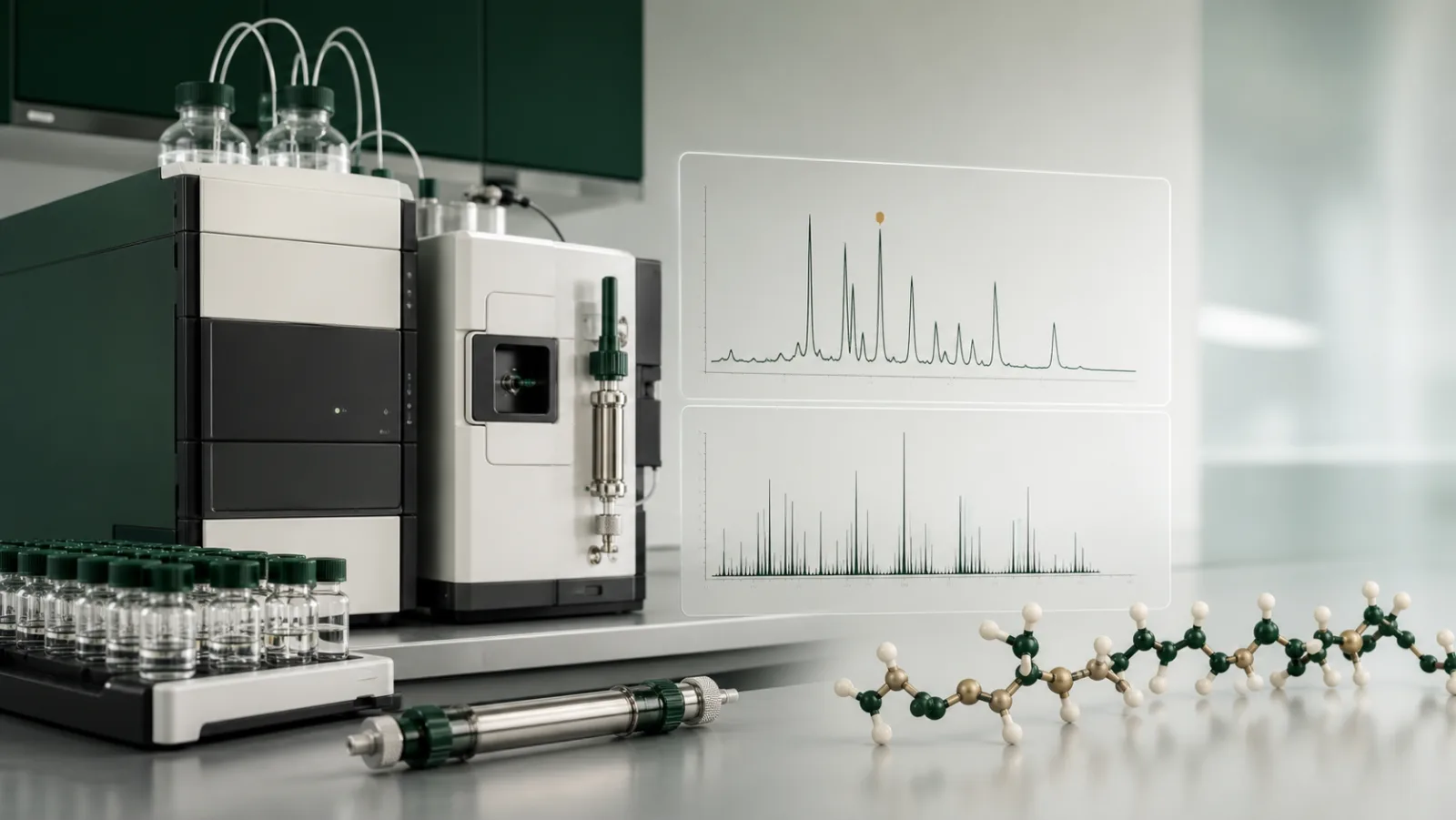
Useful attachments can include a chromatogram and mass spectrum. Check that filenames, sample identifiers and dates are consistent with the certificate. An image pasted into a template without traceable axes, method conditions or sample identity is weak evidence.
How should purity and content be interpreted?
Chromatographic purity usually reports the relative area of peaks detected under one HPLC method. It does not count water, residual solvents, salts or every impurity that lacks the same detector response. A 98 percent purity value is therefore not automatically 98 percent peptide by vial mass.
For concentration-sensitive work, ask whether peptide content or assay has been established and on what basis. Counter-ion analysis, water determination and residual-solvent testing may be needed to understand the gap between gross mass and net peptide. Document the basis used in calculations.
What does mass spectrometry establish?
An intact mass near the theoretical value supports molecular identity. It may not distinguish leucine from isoleucine, locate every modification or prove sequence order by itself. Tandem MS, amino-acid analysis, NMR or comparison with a reference standard can add orthogonal evidence when the project risk requires it.
Ask whether the reported mass is neutral, average, monoisotopic or an observed charge state. The certificate should make the comparison understandable instead of presenting a screenshot that only an instrument operator can decode.
What is the role of the SDS?
The Safety Data Sheet summarizes classification, hazards, first aid, handling, storage, transport and disposal information. It supports workplace controls. It is not an analytical certificate and should not be used as evidence that the sequence or purity is correct.
Check whether the SDS covers the supplied form and associated counter-ion. Institutional environmental health and safety teams may require a local risk assessment even when a supplier classifies the material as not hazardous. The laboratory remains responsible for its conditions of use.
What should trigger a procurement hold?
Pause when the lot is missing, the sequence conflicts with the label, the analytical result lacks a method, the certificate date is implausible or the supplier will not answer a documentation question. A delay before use is easier to manage than invalidating a completed experiment. Record the resolution so future buyers do not repeat the same review.
Continue through the evidence
Methods and quality. How to Read a Peptide Certificate of Analysis, HPLC Peptide Purity: How to Read a Chromatogram Without Overclaiming, LC-MS for Peptide Identity: Molecular Mass, Charge States and Sequence Evidence and Albumin Binding and Acylated Peptides: A Research Methods Guide.
Canadian research context. Peptide Research in Vancouver: Laboratories, Methods and Procurement.
Connected peptide briefings. Research Peptides in Canada: A Laboratory Procurement Guide, Health Canada, Peptides and Research Use Only: What the 2026 Guidance Means, Shipping and Storing Research Peptides Across Canada, Canadian Clinical Trial Rules for Peptide Investigators, Importing Research Peptides into Canada: Questions Laboratories Should Ask, Thymosin Alpha-1 and COVID-19: A 2020 Historical Evidence Review and AI Search for Peptide Literature: A Reproducible Review Workflow.
Sources and further literature
- USP: Reference standards to support quality of synthetic peptide therapeuticsReview of peptide identity, purity, counter-ion and strength testing.
- Health Canada: Regulating health productsOverview of authorization, monitoring and compliance.
- ICH Q2(R2): Validation of analytical proceduresInternational framework for fit-for-purpose analytical validation.
North Specs separates scientific education from product claims. Review primary literature, current regulations and institutional requirements before designing laboratory work.