Direct answer
TB-500 is often conflated with full-length thymosin beta-4. This briefing separates sequence identity, literature scope and experimental claims.
- TB-500 is a marketplace term that may refer to a fragment or formulation and should not be assumed to equal the 43-residue thymosin beta-4 protein.
- Full-length thymosin beta-4 findings cannot be assigned to a shorter fragment without direct sequence-specific evidence.
- Research records should identify exact sequence, termini, salt form and content rather than relying on an ambiguous common name.
What is thymosin beta-4?
Thymosin beta-4 is a 43-amino-acid actin-binding peptide found in many tissues. Published research has examined cytoskeletal regulation, cell migration, angiogenic signaling and tissue-repair models. The molecule has a specific sequence and structural identity, even when literature uses shorthand such as T beta 4.
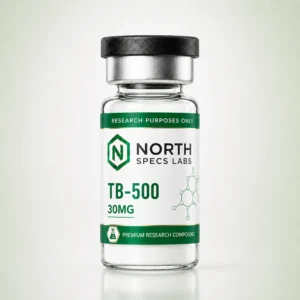
TB-500 is not a consistently defined scientific synonym. Commercial usage may point to a fragment, a product label or material represented as related to thymosin beta-4. A paper about full-length peptide does not characterize every product sold under that label.
Why does sequence identity change the inference?
A fragment can lose binding regions, adopt different conformations, clear differently and show different solubility or adsorption. Even if a short motif is proposed to carry an activity, the fragment needs direct testing with authenticated material and appropriate controls. Biological similarity cannot be established from shared residues alone.
Check the exact sequence, molecular mass and terminal modifications on the certificate. If a supplier does not define them, the material cannot be mapped reliably to literature.
How should a comparison study be designed?
Test full-length thymosin beta-4 and the defined fragment side by side on a content-corrected molar basis. Include vehicle and a mechanistic control, balance plate positions and use independent preparations. Measure recovery because fragments and full-length peptides can adsorb or aggregate differently.
If the endpoint involves actin binding or cell migration, pair the phenotypic readout with a direct pathway measurement. A single wound-closure assay can be influenced by proliferation, toxicity and imaging choices.
What is the regulatory boundary?
Health Canada names TB-500 among unauthorized peptide products of concern in its 2026 public advisory. That warning and the literature distinction point in the same direction: a research label does not establish medical use, and a familiar name does not establish molecular equivalence. Product links here are strictly for qualified laboratory procurement.
Continue through the evidence
Methods and quality. Peptide Amidation, Acetylation and Other Terminal Modifications, How to Read a Peptide Certificate of Analysis, HPLC Peptide Purity: How to Read a Chromatogram Without Overclaiming and LC-MS for Peptide Identity: Molecular Mass, Charge States and Sequence Evidence.
Connected peptide briefings. TB-500 and Thymosin Beta-4: Actin Dynamics in Tissue Repair Research, BPC-157 Research: Evidence Gaps and Replication-First Study Design, Research Peptides in Canada: A Laboratory Procurement Guide, Health Canada, Peptides and Research Use Only: What the 2026 Guidance Means, Shipping and Storing Research Peptides Across Canada, CJC-1295 With DAC: Albumin Binding and Growth Hormone Axis Research, GHK-Cu Research: Copper Coordination and Experimental Design and Ipamorelin and Hexarelin: Ghrelin Receptor Selectivity in Research.
Sources and further literature
- Thymosin beta-4 promotes corneal wound healingFoundational animal and ex-vivo research on full-length thymosin beta-4.
- Thymosin beta-4 and tissue repair reviewReview of full-length thymosin beta-4 biology and repair literature.
- Health Canada: Think twice before injecting peptides bought onlineApril 2026 federal warning about unauthorized peptide products.
North Specs separates scientific education from product claims. Review primary literature, current regulations and institutional requirements before designing laboratory work.