Direct answer
A research-only guide for Winnipeg laboratories evaluating peptide identity, documentation, methods and delivery across Canada.
- Winnipeg has a real research context in proteomics, systems biology, infectious-disease research, immunology and clinical translation, but each project still needs a defined peptide role and validated endpoint.
- Identity, purity, peptide content, counter-ion, lot traceability and storage evidence answer different quality questions.
- North Specs supports research-only delivery across Canada where checkout service, carrier access, product requirements and applicable law permit.
- A Research Use Only label is not, by itself, a Health Canada authorization or a blanket exemption from Canadian requirements.
What research peptides mean for Winnipeg laboratories
Research peptides are defined amino-acid sequences used as analytical targets, calibration materials, enzyme substrates, receptor ligands or controlled experimental perturbations. In Winnipeg and southern Manitoba, relevant work can include proteomics, systems biology, infectious-disease research, immunology and clinical translation. Those uses are laboratory questions, not consumer health claims, and the experimental role should be written into the study plan before any material is ordered.
A catalogue peptide is not automatically a certified reference material, a therapeutic product or a validated assay component. The receiving laboratory remains responsible for confirming that the product specification, documentation and intended use are compatible with its institution, method and applicable Canadian requirements.
The Winnipeg research ecosystem
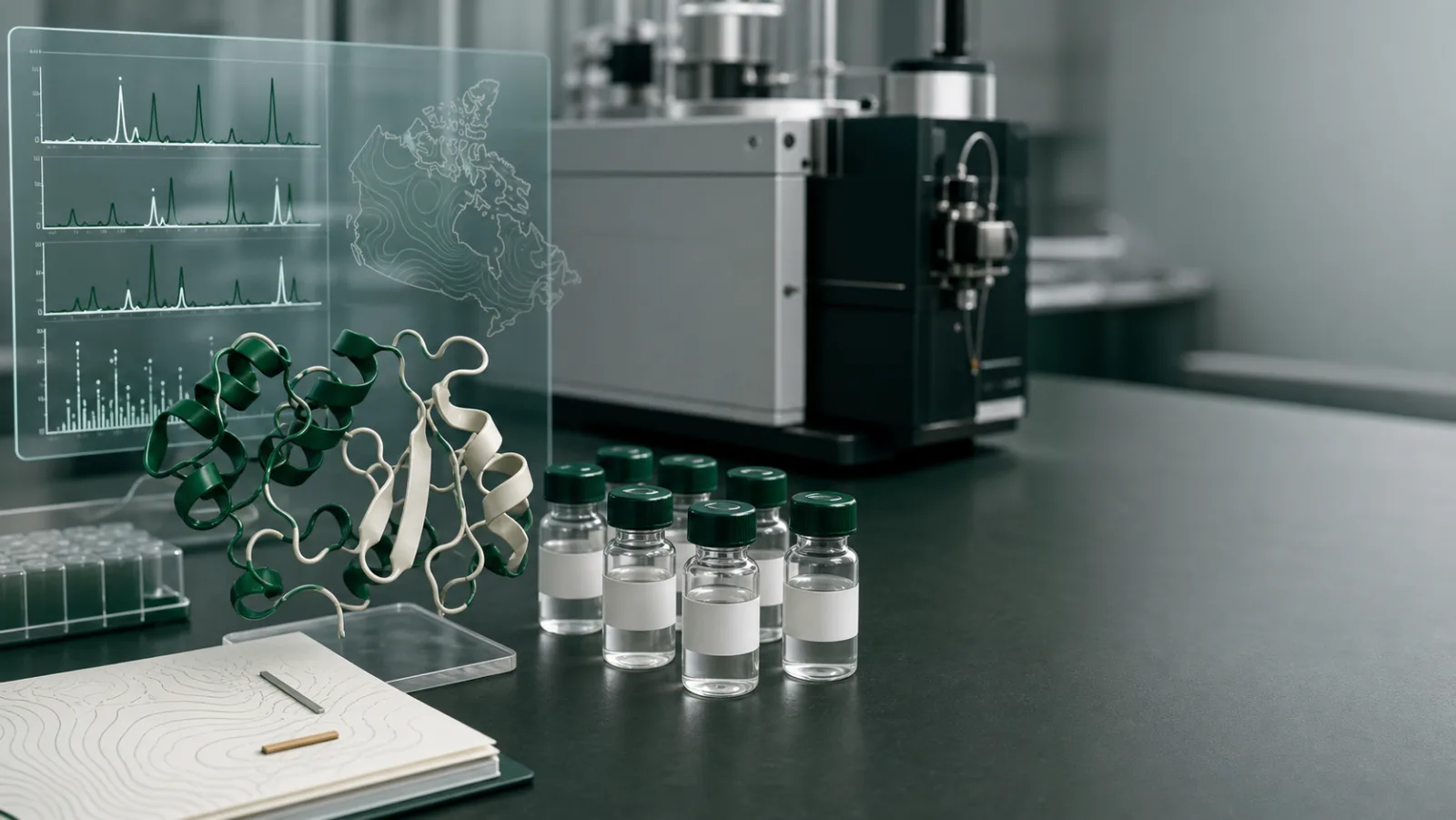
Winnipeg has a substantial peptide-adjacent research base through the University of Manitoba, the Manitoba Centre for Proteomics and Systems Biology, hospital research institutes and federal infectious-disease infrastructure. The proteomics centre describes advanced LC-MS instrumentation, targeted quantification and computational workflows. Peptide experiments can benefit from that capacity when the material is tied to a defined assay and the quantitative basis is documented.
The local source listed with this guide documents a relevant part of the Winnipeg ecosystem. It does not endorse North Specs or any catalogue product. It is included so researchers can verify real regional capability, identify possible core-facility constraints and avoid treating a city keyword as a substitute for scientific context.
Quality attributes to evaluate before procurement
Begin with sequence, modifications and expected molecular formula, then review chromatographic purity, mass evidence, net peptide content, counter-ion or salt form, water or volatile content and lot identifiers. A high HPLC area percentage describes a result under one method. It does not independently prove sequence, exact mass, concentration, sterility, endotoxin status or biological activity.
Immunology and infection studies need numerical endotoxin evidence, matrix controls and an analysis plan that separates peptide response from contamination or cell-state effects.
Analytical design and reproducibility
An evidence-led workflow uses orthogonal measurements. Reversed-phase HPLC can describe chromatographic composition, intact-mass spectrometry can test expected mass, and tandem methods can add sequence evidence. Concentration or content may require amino-acid analysis, quantitative NMR or a qualified reference approach. The right combination depends on the decision the data must support.
Biological experiments also need vehicle, matrix and negative controls, an adequate concentration range, replicate logic and prespecified exclusions. Record the supplier, catalogue number, lot, preparation calculation, solvent, vessel material, freeze-thaw history and instrument sequence so a result can be audited or repeated by another laboratory.
Research-only delivery to Winnipeg
Winnipeg is the principal distribution hub for Manitoba and often the staging point for northern shipments. Laboratories should distinguish a delivery completed in Winnipeg from an onward carrier movement to another community and preserve custody records at each transfer.
North Specs offers delivery for qualified research orders across Canada, including Winnipeg, when the address, checkout options, carrier access, product requirements and applicable law allow service. Availability and timing are confirmed during ordering rather than promised by this educational page. On arrival, compare the item and lot with the order, inspect the package, record the receipt time and move the material into the laboratory’s approved storage process.
Canadian regulatory and institutional responsibilities
Canadian status cannot be reduced to the words Research Use Only on a label. Health Canada considers the product, intended use, claims, presentation, purchaser controls and surrounding facts. Its April 2026 advisory specifically warns that an RUO label alone does not make an unauthorized health product lawful. Researchers should use the Drug Product Database and official guidance when authorization status is relevant.
North Specs materials are supplied strictly for qualified laboratory research and are not for human or veterinary use. They are not medicines, supplements, foods or diagnostic products. Purchasers are responsible for institutional approval, lawful possession, worker safety, biosafety, waste handling and any separate ethics, animal-care, field-research or territorial licensing requirements.
A procurement checklist for Winnipeg research teams
Before ordering, document the experimental question, exact sequence and modification, required amount, acceptance tests, storage plan and receiving contact. Review the available Certificate of Analysis or request the lot record, then decide whether the supplier data are sufficient or whether incoming identity, content or stability testing is required under the laboratory quality system.
Schedule the experiment only after the material has arrived, passed receiving review and been entered into inventory. Link raw analytical files and prepared aliquots back to the supplier lot. If results are unexpected, investigate material identity, adsorption, solubility, degradation, assay controls and instrument suitability before assigning a biological explanation.
Continue through the evidence
Methods and quality. How to Read a Peptide Certificate of Analysis, HPLC Peptide Purity: How to Read a Chromatogram Without Overclaiming and LC-MS for Peptide Identity: Molecular Mass, Charge States and Sequence Evidence.
Canadian research context. Peptide Research in Manitoba: A Laboratory Methods Guide, Research Peptides in Brandon, MB: A Laboratory Guide, Research Peptides in Thompson, MB: A Laboratory Guide, Research Peptides in Fort McMurray, AB: A Laboratory Guide, Research Peptides in Fredericton, NB: A Laboratory Guide and Research Peptides in Guelph, ON: A Laboratory Guide.
Connected peptide briefings. Research Peptides in Canada: A Laboratory Procurement Guide, Health Canada, Peptides and Research Use Only: What the 2026 Guidance Means and Shipping and Storing Research Peptides Across Canada.
Sources and further literature
- University of Manitoba: Manitoba Centre for Proteomics and Systems BiologyOfficial Winnipeg proteomics and systems-biology facility.
- Health Canada: Think twice before injecting peptides bought onlineOfficial April 2026 advisory explaining that Research Use Only labels do not create a blanket regulatory exemption.
- Health Canada Drug Product DatabaseOfficial database for checking authorized drug products in Canada.
- USP: Reference standards supporting synthetic peptide qualityScientific quality discussion covering peptide identity, purity and reference standards.
North Specs separates scientific education from product claims. Review primary literature, current regulations and institutional requirements before designing laboratory work.