Direct answer
A laboratory guide to designing and interpreting peptide concentration-response experiments without confusing potency, efficacy and system bias.
- EC50 is an assay-system parameter, not a direct synonym for binding affinity or an intrinsic universal property.
- A useful curve spans both plateaus and preserves raw replicate points, fitting constraints and independent experiment counts.
- Delivered concentration, receptor expression and signal amplification can shift apparent potency.
What do EC50 and Emax mean?
EC50 is the concentration producing half of the fitted maximal response in a particular assay. Emax is the response plateau under those conditions. Neither is independent of the biological system. Receptor density, coupling efficiency, signal amplification, incubation time and normalization can change both values without changing the ligand itself.
Binding affinity measures a different relationship and should not be inferred from a functional EC50 unless a justified model connects them.
How should the concentration range be chosen?
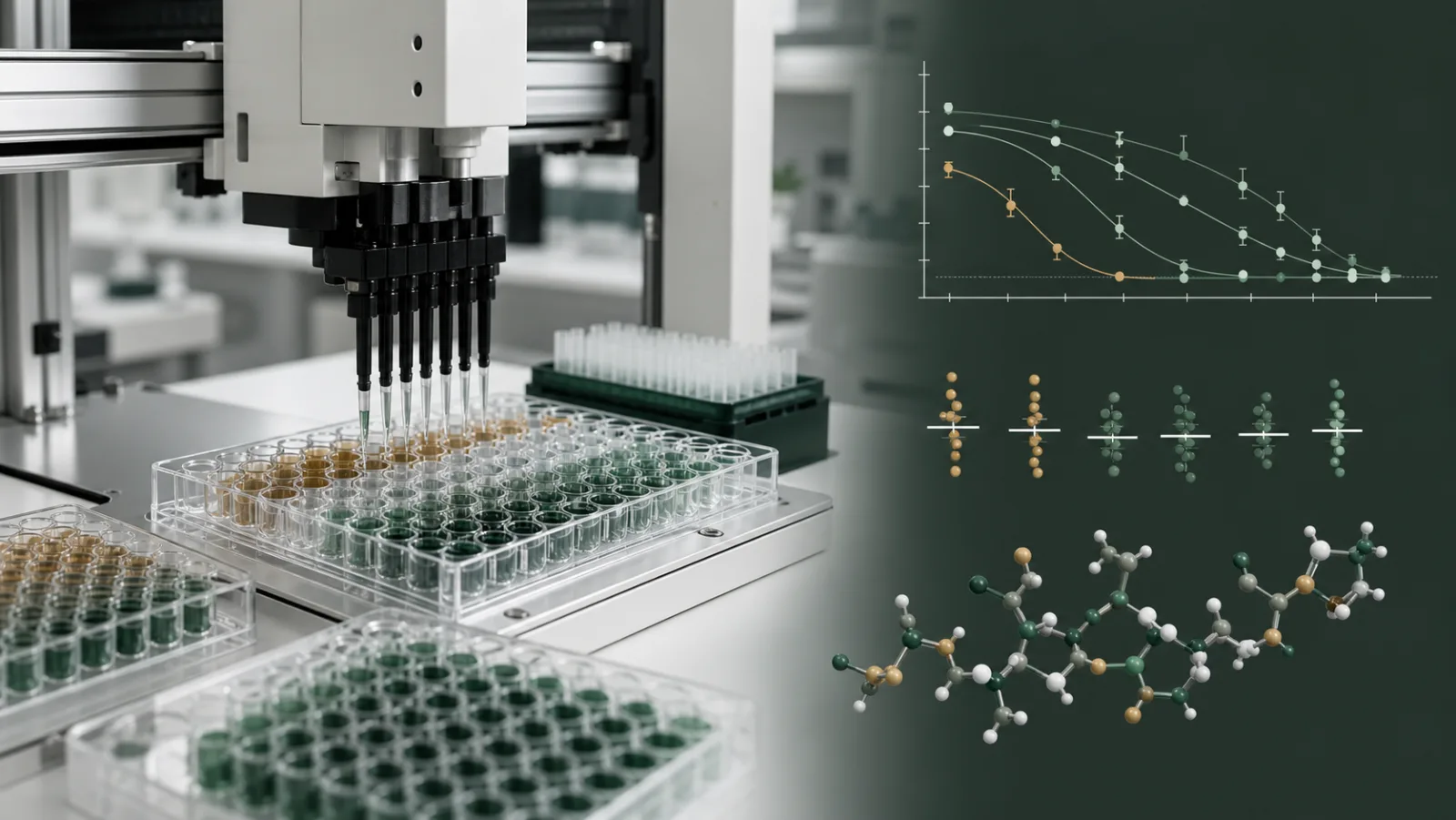
Use pilot data or literature to choose a log-spaced range that captures baseline, transition and upper plateau. A fit based only on the rising portion can return a precise but unstable EC50. Include enough concentrations to diagnose non-monotonic effects, precipitation or cytotoxicity at the upper end.
Prepare dilutions in a matrix demonstrated to recover the peptide. Low-binding losses, serial-dilution error and adsorption can distort the lower range. Randomize positions or balance the plate so time and edge effects do not track concentration.
What controls and replicates are needed?
Include vehicle, a reference agonist or antagonist where relevant, and a viability or nonspecific-response check. Technical replicates estimate within-run noise; independent biological experiments establish repeatability across days, passages or preparations. Do not present many wells from one experiment as many independent experiments.
Predefine normalization and exclusion. A plate-specific control can correct run amplitude, but normalizing every curve to its own maximum may conceal meaningful efficacy differences.
How should curves be reported?
Show raw or minimally transformed replicate points, fitted model, confidence intervals, Hill slope, Emax, EC50 and number of independent experiments. State whether parameters were constrained and how incomplete curves were handled. Compare log-transformed potency estimates using a suitable statistical model rather than comparing overlapping error bars by eye.
The aim is not merely a smooth sigmoid. It is an experimental account that another laboratory can reproduce and critique.
Continue through the evidence
Methods and quality. GLP-1 Receptor Assay Design: Controls, Curves and Interpretation, Receptor Bias and Potency in Incretin Peptide Research, Peptide Experimental Controls: Vehicle, Scrambled Sequence and Reference Ligands, How to Read a Peptide Certificate of Analysis, HPLC Peptide Purity: How to Read a Chromatogram Without Overclaiming, LC-MS for Peptide Identity: Molecular Mass, Charge States and Sequence Evidence, Albumin Binding and Acylated Peptides: A Research Methods Guide and Peptide Amidation, Acetylation and Other Terminal Modifications.
Connected peptide briefings. Research Peptides in Canada: A Laboratory Procurement Guide, Health Canada, Peptides and Research Use Only: What the 2026 Guidance Means, Shipping and Storing Research Peptides Across Canada and Incretin Research: GLP-1, GIP and the Move to Multi-Receptor Agonists.
Sources and further literature
- ICH Q2(R2): Validation of Analytical ProceduresInternational framework for validation and method performance.
- FDA: Analytical Procedures and Methods Validation for Drugs and BiologicsOfficial analytical-method lifecycle guidance.
- Peptide and protein adsorption to laboratory consumablesExperimental comparison of low-binding materials and analyte recovery.
North Specs separates scientific education from product claims. Review primary literature, current regulations and institutional requirements before designing laboratory work.