Direct answer
A practical guide to designing GLP-1 receptor assays, including receptor reserve, reference agonists, albumin, adsorption and curve analysis.
- A GLP-1 receptor curve needs a reference agonist, parental-cell or no-receptor control, vehicle control and replicate structure.
- Receptor expression and signal amplification can shift apparent potency through receptor reserve.
- Acylated agonists require explicit albumin and surface-adsorption controls.
What question should the assay answer?
An assay can measure binding, cAMP generation, beta-arrestin recruitment, receptor internalization, transcriptional response or a downstream cellular phenotype. These endpoints are not interchangeable. Select the endpoint that matches the hypothesis, then define an acceptance range before testing unknowns.
For screening, throughput and robustness may matter most. For mechanistic comparison, receptor density and pathway choice need tighter control. For potency assignment, the method requires a qualified concentration range and reference material.
Which controls are essential?
Include a well-characterized GLP-1R agonist, vehicle, untransfected or parental cells and a no-cell or background control appropriate to the readout. A receptor antagonist or genetic control can strengthen attribution. When comparing multi-agonists, test related receptors in matched systems.
Randomize plate position where practical and watch for edge effects. Use independent preparations across runs rather than treating technical wells from one preparation as full biological replication. A plate map should be preserved with the raw data.
How does receptor reserve affect potency?
High receptor expression can allow a partial agonist or low-occupancy ligand to generate a large downstream response. Apparent EC50 can therefore reflect the cell system as much as ligand affinity. Compare expression levels, use more than one readout or titrate receptor expression when the scientific claim concerns intrinsic pharmacology.
Report maximal response relative to the reference agonist and avoid converting every curve difference into binding affinity. Functional potency integrates binding, activation, coupling and amplification.
Why do albumin and plastic matter?
Long-acting analogues often contain fatty-acid modifications that bind albumin. Protein in the medium can lower the immediately free ligand concentration while improving solubility or reducing surface loss. State the albumin source and concentration, and do not compare results from protein-free and protein-rich media as if exposure were identical.
Peptides can adsorb to tips, tubes and plates, especially at low concentration. Use a validated low-binding workflow, minimize transfers and perform a recovery check. A steep loss at the low end can distort the curve shape.
How should curves be reported?
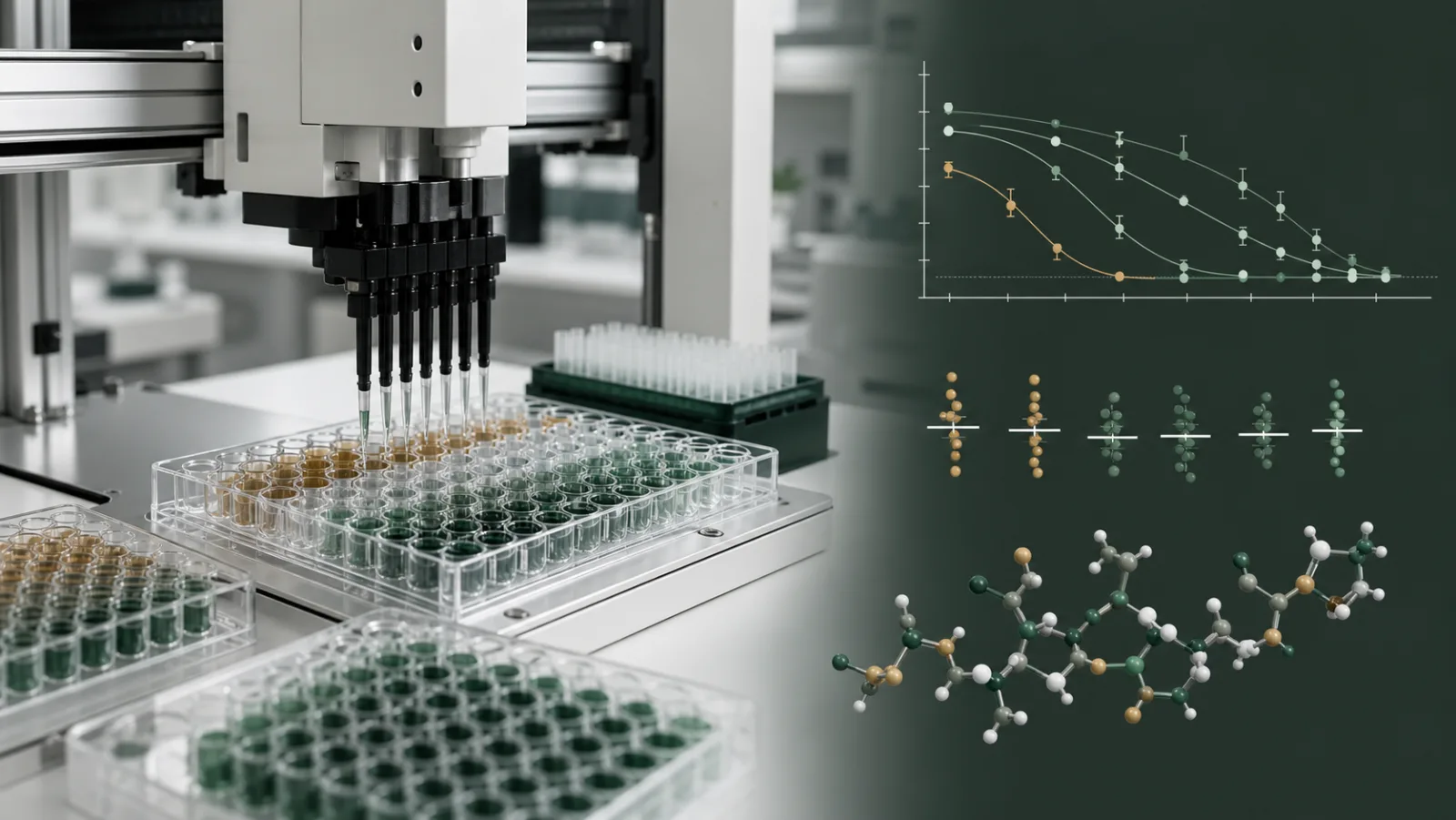
Show individual points, replicate definition, fitted model, confidence intervals, top and bottom constraints and the number of independent experiments. Inspect residuals and failed fits. A single EC50 without maximal response or curve quality is not enough to compare ligands.
Continue through the evidence
Methods and quality. Peptide Dose-Response Curves: EC50, Emax and Assay Design, Peptide Experimental Controls: Vehicle, Scrambled Sequence and Reference Ligands, Receptor Bias and Potency in Incretin Peptide Research, How to Read a Peptide Certificate of Analysis, HPLC Peptide Purity: How to Read a Chromatogram Without Overclaiming, LC-MS for Peptide Identity: Molecular Mass, Charge States and Sequence Evidence and Albumin Binding and Acylated Peptides: A Research Methods Guide.
Connected peptide briefings. Low-Binding Tubes and Peptide Adsorption: Preventing Invisible Sample Loss, Research Peptides in Canada: A Laboratory Procurement Guide, Health Canada, Peptides and Research Use Only: What the 2026 Guidance Means, Shipping and Storing Research Peptides Across Canada and Incretin Research: GLP-1, GIP and the Move to Multi-Receptor Agonists.
Sources and further literature
- Structural insights into retatrutide triple agonismCryo-EM and receptor-structure study, 2024.
- FDA Q2(R2) validation of analytical proceduresFit-for-purpose validation principles applicable to quantitative assay thinking.
- PubMed: Adsorption effects in intact peptide LC-MS quantitationEvidence that low-bind tubes and vials can improve low-concentration response.
North Specs separates scientific education from product claims. Review primary literature, current regulations and institutional requirements before designing laboratory work.