Direct answer
A scientific overview of freeze-drying, residual water, hygroscopicity and the storage records needed to preserve peptide research material.
- Lyophilization removes water under reduced pressure but does not guarantee a water-free or equally stable cake.
- Residual moisture, excipients, vial closure and exposure during handling affect stability after manufacture.
- Storage claims should be supported for the specific material and state, not copied from an unrelated peptide.
What does lyophilization do?
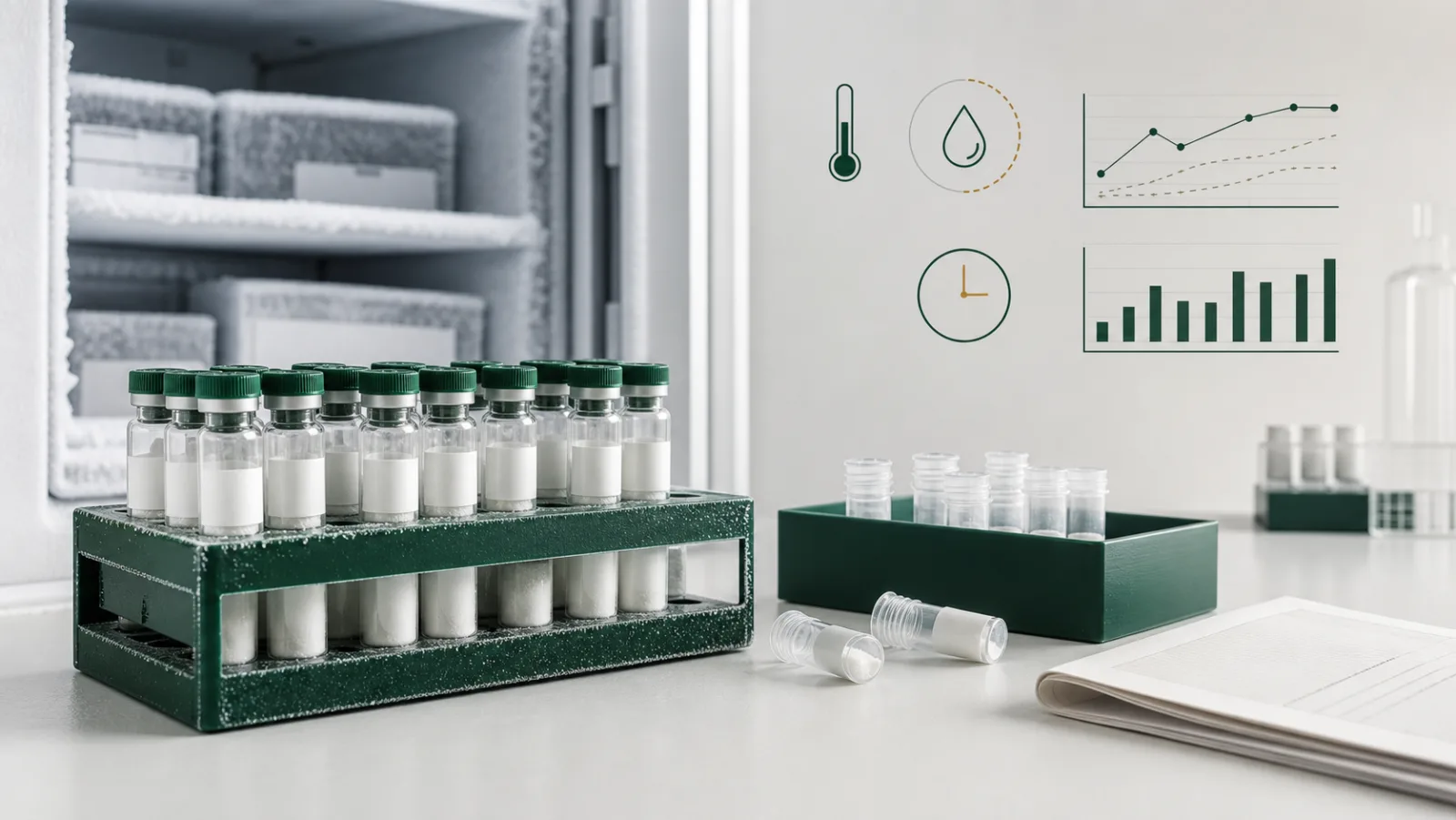
Freeze-drying first freezes a peptide solution, then removes ice by sublimation during primary drying and more tightly associated water during secondary drying. The process can improve shelf stability and create a porous cake that dissolves predictably. It also introduces stress from freezing, interfaces, concentration of solutes and drying. Cycle design must balance removal of moisture with protection of the molecule and formulation.
A dry-looking vial is not proof of a successful cycle. Collapse, shrinkage or an irregular cake may signal process problems, but acceptable appearance does not establish low water or preserved potency. Analytical measurements and stability data are needed.
Why does residual water matter?
Residual water can plasticize the solid matrix and increase molecular mobility, accelerating some chemical or physical changes. Too little water can also destabilize certain formulations when a small hydration shell is protective. The relevant range depends on sequence, excipients, amorphous or crystalline state, closure and temperature.
Water adds to gross mass, so it also changes the relationship between weighed material and net peptide content. Karl Fischer titration is commonly used, but sampling should minimize atmospheric uptake. Hygroscopic cakes can change while a vial is open, especially in humid environments.
What storage variables deserve a record?
Record storage temperature, light protection, closure integrity, receipt condition and every interval outside the defined environment. Avoid relying on labels such as refrigerated or frozen without actual ranges. A monitored freezer and a shipment temperature indicator answer different parts of the chain-of-custody question.
After opening, minimize repeated exposure to room air and moisture. If the material will be used across many experiments, a documented aliquoting plan can reduce handling. Do not assume that a lyophilized peptide and its solution share the same stability profile.
How should a storage claim be supported?
A useful stability programme uses a method capable of distinguishing relevant degradation, appropriate time points and storage conditions that match the claim. HPLC may follow new impurity peaks, while mass spectrometry can help identify oxidation, clipping or adducts. Appearance, water and reconstitution behavior can add physical information.
Literature on another peptide can suggest risks, not prove a shelf life. The sequence, formulation and container system determine whether aggregation, oxidation, deamidation or adsorption dominates. Supplier recommendations should be treated as lot or product guidance, then reconciled with the laboratory protocol.
What belongs in a methods section?
State whether material was lyophilized, how it was stored, how long it remained in storage, whether it was opened or aliquoted and how excursion decisions were made. If water or content corrections were applied, report them. These details turn storage from an invisible assumption into a reproducible part of the experiment.
Continue through the evidence
Methods and quality. How to Read a Peptide Certificate of Analysis, HPLC Peptide Purity: How to Read a Chromatogram Without Overclaiming, LC-MS for Peptide Identity: Molecular Mass, Charge States and Sequence Evidence and Albumin Binding and Acylated Peptides: A Research Methods Guide.
Canadian research context. Peptide and Proteomics Research in Alberta.
Connected peptide briefings. Peptide Freeze-Thaw Stability: Designing a Defensible Study, Peptide Solubility, Aggregation and Buffer Selection, Shipping and Storing Research Peptides Across Canada, Research Peptides in Canada: A Laboratory Procurement Guide, Health Canada, Peptides and Research Use Only: What the 2026 Guidance Means, Low-Binding Tubes and Peptide Adsorption: Preventing Invisible Sample Loss and BPC-157 Research: Evidence Gaps and Replication-First Study Design.
Sources and further literature
- USP: Reference standards to support quality of synthetic peptide therapeuticsReview of identity, purity, content, counter-ion and strength testing.
- Aggregation and physicochemical stability of liraglutideRecent experimental work illustrating peptide aggregation and stability variables.
- ICH Q2(R2): Validation of Analytical ProceduresInternational framework for analytical procedure validation.
North Specs separates scientific education from product claims. Review primary literature, current regulations and institutional requirements before designing laboratory work.