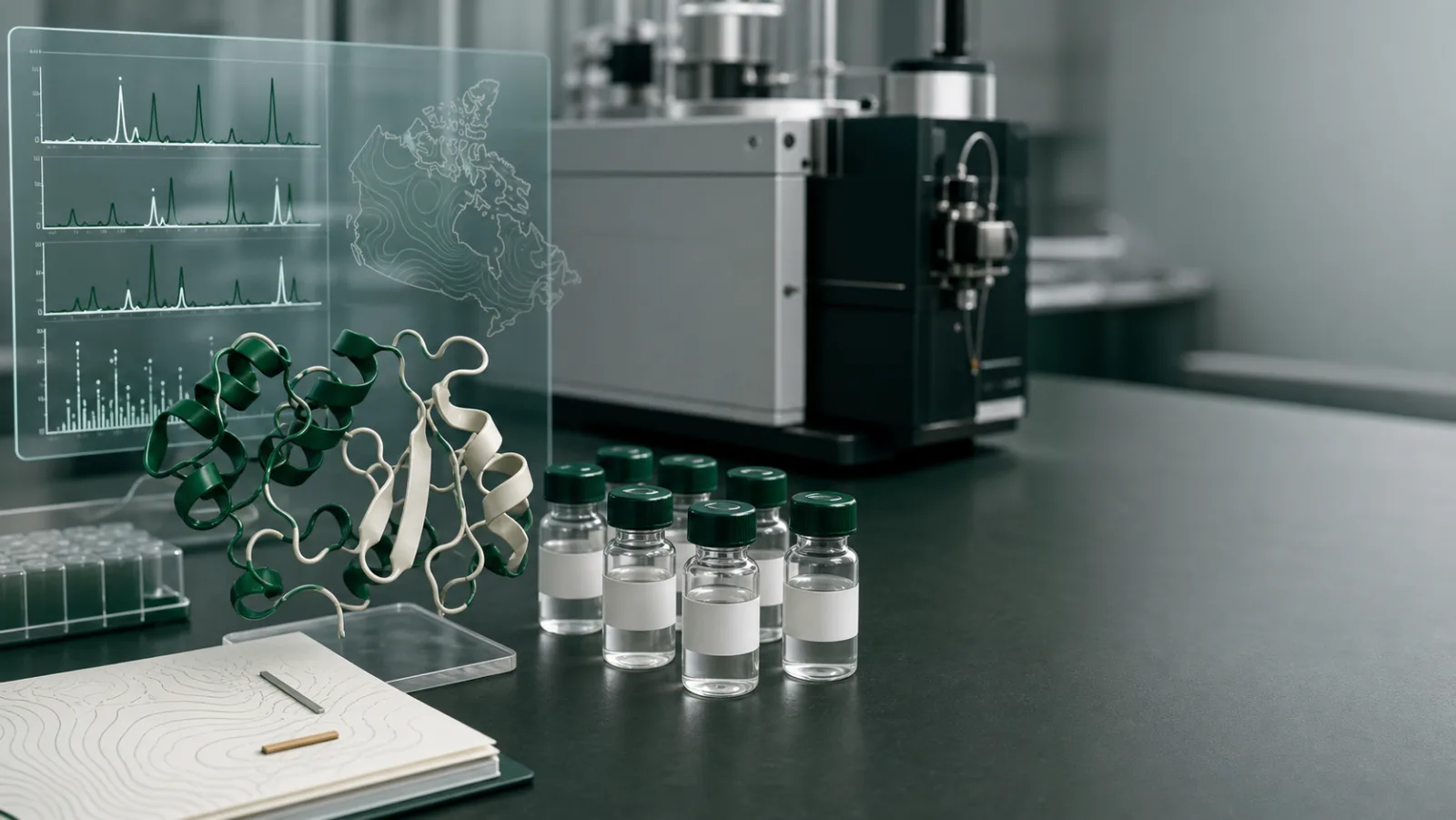
Canada's relationship with peptide science begins with insulin. The 1921 work at the University of Toronto that isolated and purified a pancreatic extract into a usable therapeutic was, in modern terms, peptide research, and it established a domestic tradition in protein and peptide biochemistry that persists.
This article surveys how that field is organised today: who funds it, where it is concentrated, and the regulatory framework a Canadian laboratory works within when acquiring research-use peptides.
All products supplied by North Specs Labs are Research Use Only and are not for human or veterinary use.
Funding structure
Federal support flows mainly through three agencies, collectively the Tri-Council.
Canadian Institutes of Health Research (CIHR) funds health research and is the primary source for peptide work with a biomedical orientation, including metabolic, oncology and neuroscience applications.
Natural Sciences and Engineering Research Council (NSERC) supports the underlying chemistry: synthesis methodology, analytical technique, structural biology and biomaterials.
Canada Foundation for Innovation funds the infrastructure, which matters disproportionately in this field. Peptide work depends on mass spectrometry, NMR and structural biology facilities that individual grants rarely cover.
Provincial agencies add a further layer, with Quebec's Fonds de recherche du Québec and Ontario's provincial programmes among the more active. Genome Canada supports work at the intersection of genomics and protein science, which has become relevant as microprotein and mitochondrial-derived peptide research has grown.
Where the work happens
University of Toronto and its affiliated hospital network remains the largest concentration, with the insulin lineage continuing through diabetes and metabolic research at the Banting and Best department and associated institutes.
McGill University has long-standing strength in endocrinology and structural biology.
University of British Columbia hosts significant work in protein engineering and biologics, and the surrounding Vancouver biotechnology cluster has produced companies working in peptide and protein therapeutics.
Université de Montréal and Université de Sherbrooke have notable programmes in peptide chemistry and receptor pharmacology, with Sherbrooke in particular known for work on G-protein coupled receptor ligands.
University of Alberta and University of Calgary contribute in metabolic and cardiovascular research.
The National Research Council operates facilities relevant to biologics development, and the country's synchrotron at the Canadian Light Source in Saskatoon supports structural work on peptide-receptor complexes.
Regulatory framework for research materials
This is the part that most directly affects a working laboratory.
Health Canada regulates therapeutic products under the Food and Drugs Act and its regulations. A peptide sold or represented for use in humans or animals falls within that framework and requires authorisation. A peptide supplied strictly for laboratory research, not represented for therapeutic use, sits outside the therapeutic product authorisation pathway. That distinction is what the Research Use Only designation exists to mark, and it depends on the material genuinely being used that way.
Controlled substances. Most research peptides are not scheduled under the Controlled Drugs and Substances Act. Researchers should nonetheless verify the status of any specific compound rather than assume, since scheduling changes and some related compounds are captured.
Import. The Canada Border Services Agency administers import, and research materials may require documentation establishing their nature and intended use. Institutional purchasers commonly find that shipments move more predictably when the consignee is an institutional address and the documentation clearly states research use.
Human and animal research oversight. Work involving human participants requires Research Ethics Board approval under the Tri-Council Policy Statement. Animal work requires Animal Care Committee approval under Canadian Council on Animal Care standards. Neither applies to in-vitro work with research chemicals, but both apply the moment a study moves into living subjects, and institutional policy generally governs the transition.
Workplace safety. The Workplace Hazardous Materials Information System governs hazard communication, labelling and safety data sheets for laboratory chemicals. Institutional environmental health and safety offices set the local requirements.
Practical considerations for Canadian laboratories
Domestic supply reduces friction. Cross-border shipments of research chemicals into Canada encounter customs inspection, brokerage charges and delays that domestic supply avoids. For temperature-sensitive material, transit time is not merely an inconvenience.
Documentation expectations. Institutional procurement and safety offices increasingly expect a batch-specific certificate of analysis on file for research chemicals. Suppliers who publish certificates against batch numbers make that straightforward.
Records. Institutions generally expect records showing what was acquired, from whom, in what quantity, and for what research purpose. This is ordinary good practice and also the evidence base if the research-use character of an acquisition is ever questioned.
Cold chain across distance. Canadian geography means shipments to northern and remote institutions have longer transit times. Lyophilised peptides tolerate ambient transit well, which is why they are shipped freeze-dried, but the storage decision on arrival matters more when the material has been in transit longer.
Current research directions
Several themes are visible in Canadian output. Metabolic peptide research continues the domestic tradition, with work on incretin biology and beta-cell function. Receptor pharmacology, particularly structure-function work on G-protein coupled receptors and biased signalling, is a genuine area of strength. Peptide-based biomaterials and self-assembling peptide systems appear in materials and biomedical engineering programmes. And antimicrobial peptide research has a substantial Canadian presence, driven by interest in alternatives to conventional antibiotics.
For a researcher entering the field domestically, the infrastructure is good, the funding structure is stable if competitive, and the regulatory position for genuine research use is clear provided the research-use character of the work is maintained in substance and not merely in labelling.
North Specs Labs supplies research-grade peptides to qualified researchers, laboratories and research institutions across Canada. All products are Research Use Only and are not for human consumption or veterinary use.
Continue through the evidence
Methods and quality. How to Read a Peptide Certificate of Analysis, HPLC Peptide Purity: How to Read a Chromatogram Without Overclaiming and LC-MS for Peptide Identity: Molecular Mass, Charge States and Sequence Evidence.
Canadian research context. Peptide Research in Vancouver: Laboratories, Methods and Procurement, Peptide Research in Toronto: An Evidence-Led Laboratory Map, The Peptide Research Landscape in Europe, The Peptide Research Landscape in the United States and Peptide Research in Manitoba: A Laboratory Methods Guide.
Connected peptide briefings. Research Peptides in Canada: A Laboratory Procurement Guide, Health Canada, Peptides and Research Use Only: What the 2026 Guidance Means, Shipping and Storing Research Peptides Across Canada and Importing Research Peptides into Canada: Questions Laboratories Should Ask.
Sources and further literature
- Health Canada Drug Product DatabaseOfficial authorization-status database.
- Health Canada: Think twice before injecting peptides bought onlineApril 2026 warning on unauthorized peptide products.
- University of Alberta Advanced Protein Materials facilityCanadian peptide and protein research infrastructure.
North Specs separates scientific education from product claims. Review primary literature, current regulations and institutional requirements before designing laboratory work.