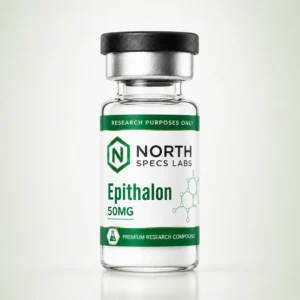
Epithalon belongs to a body of work that is difficult to evaluate from outside, not because the claims are exotic but because the literature developed under different publication conventions, largely in Russian, over several decades, with limited independent replication.
Understanding why assessment is hard is more useful than either accepting or dismissing the claims.
All products supplied by North Specs Labs are Research Use Only and are not for human or veterinary use. This article describes a research literature; it makes no therapeutic claims.
Origin
The peptide bioregulator concept originated in Soviet research beginning in the 1970s, associated principally with the St Petersburg Institute of Bioregulation and Gerontology. The founding idea was that short peptides extracted from specific tissues could regulate function in those same tissues, and that age-related decline reflected a loss of such regulatory signals which might be restored by supplying the peptides.
Epithalamin, a peptide preparation extracted from the pineal gland, was among the earliest of these. Epithalon, sometimes written epitalon, is a synthetic tetrapeptide, Ala-Glu-Asp-Gly, developed as a defined synthetic counterpart to the extract.
The move from extract to defined tetrapeptide is significant, because it means the modern compound is chemically well specified even where the biology remains contested.
The central claims
Telomerase induction. The most cited claim is that epithalon induces telomerase activity, extending telomeres in cultured human somatic cells. This is the finding that draws most interest, since telomere shortening is a recognised marker of replicative ageing.
Pineal and melatonin regulation. Given the pineal origin of the parent extract, a substantial part of the literature concerns restoration of age-disrupted melatonin rhythm and pineal function.
Lifespan effects in animals. Studies in mice, rats and Drosophila report increased mean lifespan and reduced tumour incidence in some models. The reported effects are typically on mean rather than maximum lifespan, which is a meaningful distinction: increasing average survival by reducing early mortality is different from extending the species' lifespan limit.
Antioxidant and immune effects. Various reports describe effects on oxidative stress markers and immune function in aged animals.
Why external assessment is hard
Several factors compound.
Language and access. A large share of the foundational literature is in Russian, in journals not widely indexed in Western databases. English-language reviews exist but are frequently authored by the same groups, so they are summaries rather than independent evaluations.
Concentrated authorship. Most primary work traces to a small set of affiliated institutions. The independent-replication safeguard has not been meaningfully exercised.
Methodological reporting. Study descriptions in parts of the older literature are sparse by contemporary standards. Randomisation, blinding, sample size justification and statistical treatment are often not reported in enough detail to assess.
The telomerase claim specifically. Telomerase induction in somatic cells is a strong claim. Telomerase is tightly regulated, and its activation is consequential, since it is a feature of most cancers. A short peptide with no identified receptor inducing telomerase expression would require a mechanism, and no well-characterised mechanism has been established. The in-vitro reports exist; the pathway connecting a tetrapeptide to TERT transcription does not.
Mechanism generally. Proposals include direct interaction with DNA or histones affecting gene expression. This is chemically plausible for short charged peptides in principle but has not been demonstrated with the specificity that would make it a mechanism rather than a hypothesis.
None of this establishes that the claims are wrong. It establishes that they are unverified in the sense that matters scientifically.
What a careful researcher can do with this
The compound is chemically simple, inexpensive to synthesise, and easy to characterise. The claims are testable. That combination makes it a reasonable subject for independent work, and independent work is precisely what the literature lacks.
Useful contributions would include: direct replication of the telomerase induction reports in well-controlled cell systems with appropriate positive and negative controls and quantitative TERT expression measurement; testing whether reported effects show dose-dependence, since a graded response is expected of a specific mechanism and its absence is informative; attempts to identify a binding partner; and publication of negative results, which are conspicuously absent from the existing record.
Researchers should be clear-eyed that a well-controlled replication attempt may find nothing. That would itself be a valuable contribution to a literature that currently has no published failures.
Laboratory handling
Epithalon is a tetrapeptide, Ala-Glu-Asp-Gly, and is straightforward to work with.
It is highly water-soluble owing to the two acidic residues, so reconstitution presents no difficulty. It contains no cysteine, methionine or tryptophan, so the oxidation problems affecting many peptides do not apply. Its short length makes synthesis clean and purity verification unambiguous, so a certificate reporting high purity for this sequence is more readily achieved than for a long analogue.
Standard practice otherwise applies: sealed, dry, dark, frozen storage of the lyophilised powder; equilibration to room temperature before opening; gentle reconstitution; refrigerated storage and single-use aliquoting after reconstitution.
The chief practical caution is that because the peptide is short and cheap, material quality varies more than the simplicity of the synthesis would suggest, and a batch-specific certificate remains the only basis for relying on a purity figure.
The wider bioregulator family
Epithalon is the best known of a larger group. Others associated with the same tradition include preparations directed at thymus, vascular, cartilage and other tissues, each following the same tissue-specific regulatory premise. The evidentiary situation across the family is broadly similar: a substantial internal literature, limited external replication, and mechanisms that remain proposed rather than established.
North Specs Labs supplies research-grade peptides to qualified researchers, laboratories and research institutions. All products are Research Use Only and are not for human consumption or veterinary use.
Continue through the evidence
Methods and quality. Peptide Batch Reproducibility and Acceptance Criteria, How to Read a Peptide Certificate of Analysis, HPLC Peptide Purity: How to Read a Chromatogram Without Overclaiming, LC-MS for Peptide Identity: Molecular Mass, Charge States and Sequence Evidence and Albumin Binding and Acylated Peptides: A Research Methods Guide.
Canadian research context. Peptide and Proteomics Research in Alberta.
Connected peptide briefings. AI Search for Peptide Literature: A Reproducible Review Workflow, What Research Peptides Are Actually Being Studied For, Research Peptides in Canada: A Laboratory Procurement Guide, Health Canada, Peptides and Research Use Only: What the 2026 Guidance Means, Shipping and Storing Research Peptides Across Canada and Mitochondrial-Derived Peptides: MOTS-c, Humanin and the Microprotein Field.
Sources and further literature
- PubMed Epithalon and Epitalon literatureLive query covering alternate spellings.
- Health Canada: Think twice before injecting peptides bought onlineApril 2026 warning on unauthorized peptide products.
- ICH Q2(R2): Validation of Analytical ProceduresInternational analytical validation guideline.
North Specs separates scientific education from product claims. Review primary literature, current regulations and institutional requirements before designing laboratory work.