Direct answer
How to qualify a new peptide lot, set fit-for-purpose acceptance criteria and separate analytical variation from biological drift.
- Equal catalogue name and HPLC purity do not prove two peptide lots are experimentally equivalent.
- Lot bridging should compare critical material attributes and a relevant functional endpoint using the same preparation scheme.
- Acceptance criteria should be defined before results and tied to assay variability and scientific impact.
Why can lots behave differently?
Lots may differ in peptide content, counter-ion, water, impurity profile, oxidation state, aggregation or adsorption behavior while meeting the same headline purity threshold. Biological systems add passage, day and operator variability. Without a bridging design, a lot change can be misread as a biological discovery or a failed replication.
The relevant attributes depend on use. A mass-spectrometry calibrant, receptor agonist and immunology reagent need different evidence.
What belongs in a lot bridge?
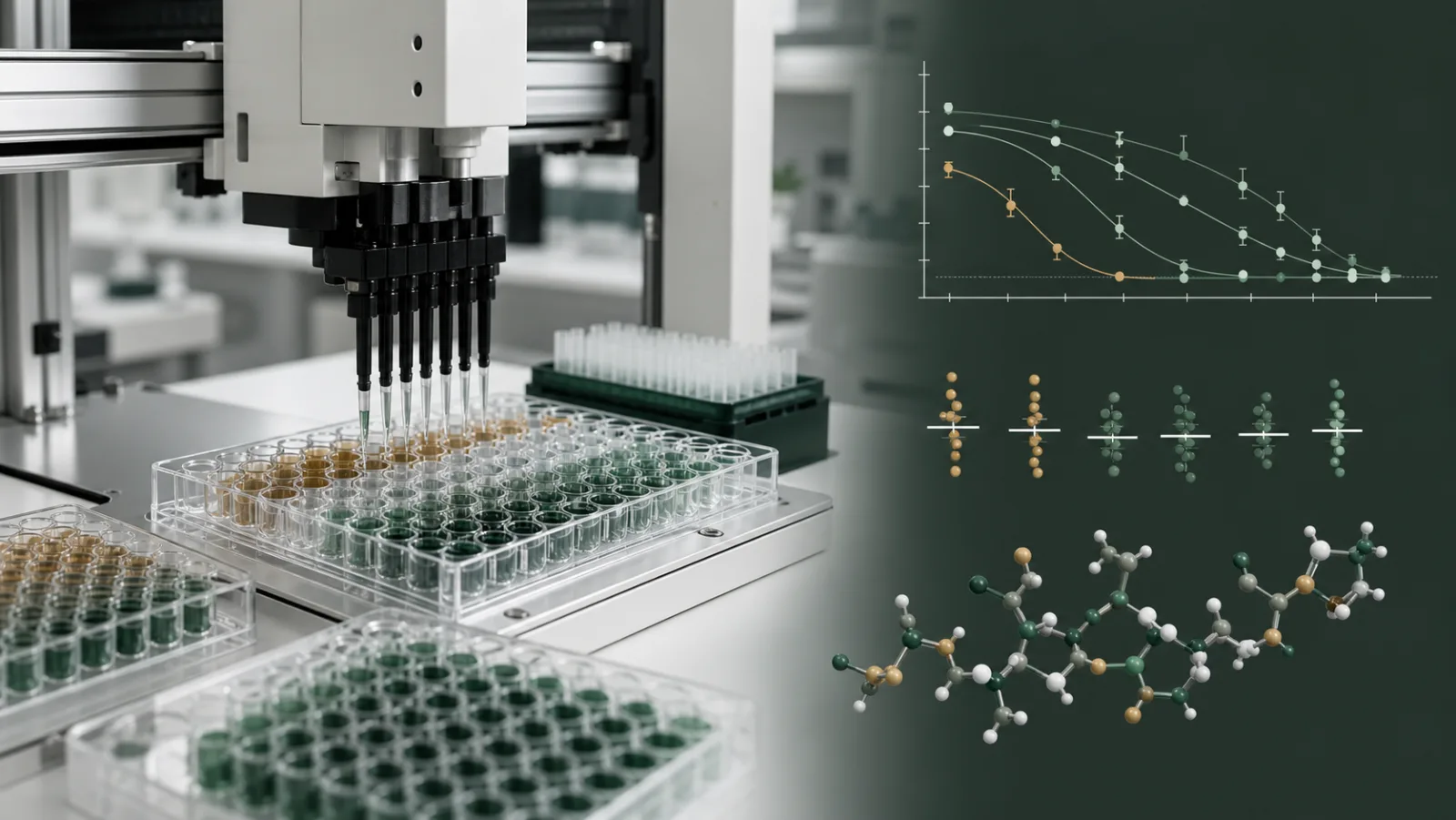
Compare certificates and, where needed, incoming identity, purity, content, counter-ion, water, recovery or endotoxin data. Prepare old and new lots side by side using the same content basis, buffer, containers and timing. In a functional assay, test overlapping concentration-response curves with shared controls and balanced plate positions.
Retain a small qualified aliquot of the prior lot when practical. It provides a direct comparator and can reveal whether the new lot or the assay system shifted.
How are criteria established?
Use historical assay precision and scientific relevance to predefine acceptable differences in recovery, potency, efficacy or impurity level. A criterion narrower than method noise creates arbitrary failures; one wider than the effect size of interest permits hidden bias. Confidence intervals and equivalence approaches can be more informative than a non-significant difference.
Document deviations and investigations. Repeating until a desired match appears destroys the value of the bridge.
What should publications disclose?
Name the supplier and lot where policy permits, report material characterization and identify lot changes across experiments. If data from multiple lots are pooled, show that lot was evaluated as a factor. Reproducibility improves when material variation is treated as part of the experiment rather than background noise.
Continue through the evidence
Methods and quality. Peptide Reference Standards and System Suitability, Peptide Content Versus Purity: Why Net Mass Changes Quantitative Experiments, Peptide Dose-Response Curves: EC50, Emax and Assay Design, How to Read a Peptide Certificate of Analysis, HPLC Peptide Purity: How to Read a Chromatogram Without Overclaiming, LC-MS for Peptide Identity: Molecular Mass, Charge States and Sequence Evidence, Peptide Experimental Controls: Vehicle, Scrambled Sequence and Reference Ligands, GLP-1 Receptor Assay Design: Controls, Curves and Interpretation and Receptor Bias and Potency in Incretin Peptide Research.
Connected peptide briefings. Research Peptides in Canada: A Laboratory Procurement Guide, Health Canada, Peptides and Research Use Only: What the 2026 Guidance Means and Shipping and Storing Research Peptides Across Canada.
Sources and further literature
- ICH Q2(R2): Validation of Analytical ProceduresInternational framework for validation and method performance.
- FDA: Analytical Procedures and Methods Validation for Drugs and BiologicsOfficial analytical-method lifecycle guidance.
- USP: Reference standards to support quality of synthetic peptide therapeuticsPeptide-specific discussion of identity, quality attributes and standards.
North Specs separates scientific education from product claims. Review primary literature, current regulations and institutional requirements before designing laboratory work.