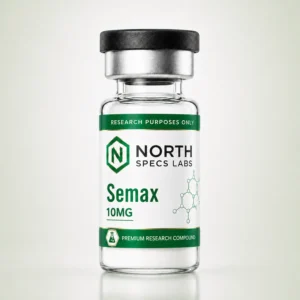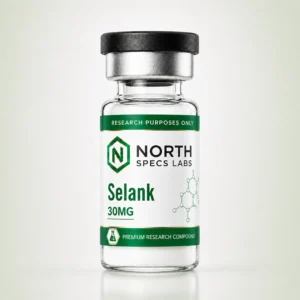
Semax and Selank share an origin and a methodological problem. Both were developed in Russian institutes from endogenous human peptide sequences, both are studied for central nervous system effects, and both have literatures concentrated in a small number of groups with limited independent replication outside them.
All products supplied by North Specs Labs are Research Use Only and are not for human or veterinary use.
Semax
Semax is a heptapeptide derived from adrenocorticotropic hormone. It corresponds to the ACTH(4-7) fragment, Met-Glu-His-Phe, extended with Pro-Gly-Pro at the C-terminus.
The design logic is worth understanding. ACTH's best-known role is stimulating adrenal cortisol release, but fragments of ACTH have long been reported to have central effects independent of that endocrine action. The 4-10 region in particular has been associated with effects on attention and memory in older literature. Semax takes a short fragment from that region and appends a tripeptide that confers resistance to enzymatic degradation, giving a peptide with the reported central activity but without the adrenal-stimulating property of intact ACTH.
Reported biology. The most-cited mechanism is upregulation of brain-derived neurotrophic factor and its receptor TrkB in the hippocampus. Additional reports describe effects on dopaminergic and serotonergic systems, on expression of genes associated with neuroprotection, and neuroprotective effects in ischaemia models.
Semax is registered as a medicine in Russia for certain indications. It has no approval in Canada, the United States, the European Union or the United Kingdom.
Selank
Selank is a heptapeptide based on tuftsin, an endogenous immunomodulatory tetrapeptide derived from immunoglobulin G. As with Semax, the native sequence is extended with Pro-Gly-Pro to slow degradation.
Reported biology. The literature centres on anxiolytic effects without the sedation or dependence associated with benzodiazepines. Proposed mechanisms include modulation of GABAergic signalling, effects on serotonin metabolism, and influence on expression of genes related to the stress response. Reported effects on enkephalin degradation provide another proposed route. Like its parent tuftsin, immunomodulatory effects are also reported.
Selank is likewise registered in Russia and not approved in Western jurisdictions.
Assessing the evidence
The two peptides share the difficulties described elsewhere for the bioregulator tradition, though somewhat less acutely.
Much of the primary literature is Russian-language and not well indexed internationally. Authorship is concentrated in the originating institutes and affiliated groups. Independent replication by unconnected laboratories is limited relative to publication volume. Methodological reporting in older work is often sparse.
There are mitigating factors. The proposed mechanisms are testable and connect to well-studied systems: BDNF and TrkB signalling for Semax, GABAergic and serotonergic function for Selank. Some independent work exists, particularly on the BDNF connection. And unlike compounds with no identified target, these have specific hypotheses that a well-equipped laboratory can evaluate directly.
The honest position is that these are plausible research subjects with real mechanistic hypotheses and an evidence base that has not been independently stress-tested to the degree the claims warrant.
The delivery question
A recurring point of contention concerns route. Much of the published work uses intranasal administration, on the premise of nose-to-brain transport bypassing the blood-brain barrier. The extent to which intranasal delivery achieves meaningful central concentrations for peptides of this size is genuinely debated, and the evidence varies by compound and formulation.
For laboratory work this matters because it determines what a given experiment can conclude. Effects observed after direct central administration establish central activity. Effects after peripheral administration require separate evidence that the peptide reached the central compartment, and that evidence is frequently assumed rather than demonstrated.
Laboratory handling
Both are short peptides and straightforward to synthesise cleanly.
Methionine in Semax. The N-terminal methionine is oxidation-susceptible. Protect from light and air, avoid extended storage in solution, and check for the characteristic mass shift if activity declines. This is the main chemical liability of the sequence.
Solubility. Both are generally water-soluble.
Proline-rich C-terminus. The Pro-Gly-Pro extension that confers stability can complicate synthesis; verify purity from the batch certificate rather than assuming a short peptide is necessarily clean.
Standard practice otherwise: sealed, dry, dark, frozen storage; room-temperature equilibration before opening; gentle reconstitution; refrigerated single-use aliquots after reconstitution.
Useful directions
The field would benefit from independent replication of the BDNF findings using quantitative methods and appropriate controls; pharmacokinetic work establishing what central concentrations are actually achieved by the routes used; dose-response characterisation rather than single-dose demonstration; and direct comparison against established reference compounds in the same behavioural models, which would place the reported effects on a scale that can be interpreted.
North Specs Labs supplies research-grade peptides to qualified researchers, laboratories and research institutions. All products are Research Use Only and are not for human consumption or veterinary use.
Continue through the evidence
Methods and quality. Peptide Experimental Controls: Vehicle, Scrambled Sequence and Reference Ligands, How to Read a Peptide Certificate of Analysis, HPLC Peptide Purity: How to Read a Chromatogram Without Overclaiming and LC-MS for Peptide Identity: Molecular Mass, Charge States and Sequence Evidence.
Canadian research context. Research Peptides in London, ON: A Laboratory Guide, Peptide Research in Vancouver: Laboratories, Methods and Procurement and Peptide Research in Manitoba: A Laboratory Methods Guide.
Connected peptide briefings. Semax Research: Neurotrophic Signaling, Models and Evidence Limits, Selank Research: GABAergic Hypotheses and Evidence Quality, Research Peptides in Canada: A Laboratory Procurement Guide, Health Canada, Peptides and Research Use Only: What the 2026 Guidance Means and Shipping and Storing Research Peptides Across Canada.
Sources and further literature
- Semax neurotrophin expression researchPreclinical molecular study.
- Selank GABAergic-system researchPreclinical mechanistic study.
- Health Canada: Think twice before injecting peptides bought onlineApril 2026 warning on unauthorized peptide products.
North Specs separates scientific education from product claims. Review primary literature, current regulations and institutional requirements before designing laboratory work.