Direct answer
A structure and assay comparison of sermorelin, tesamorelin and GHRH signaling, with attention to modifications, model choice and interpretation.
- Sermorelin and tesamorelin act within GHRH receptor research but differ in sequence design, stability and evidence context.
- GHRH receptor assays and endocrine models answer different questions and should not be collapsed into one potency ranking.
- An authorized product indication or trial result cannot be generalized to an unapproved material or unrelated use.
How are the molecules related?
Sermorelin corresponds to the biologically active N-terminal portion of human growth hormone-releasing hormone. Tesamorelin is a stabilized GHRH analogue with a trans-3-hexenoic acid group at the N terminus. Both are studied in relation to the GHRH receptor, but the modification and sequence context can change degradation, exposure and assay handling.
CJC-1295 with DAC belongs in the same broad axis but uses a different extension strategy. Ghrelin receptor agonists such as ipamorelin act through another receptor. These distinctions should define control selection.
Which assay separates receptor from endocrine effects?
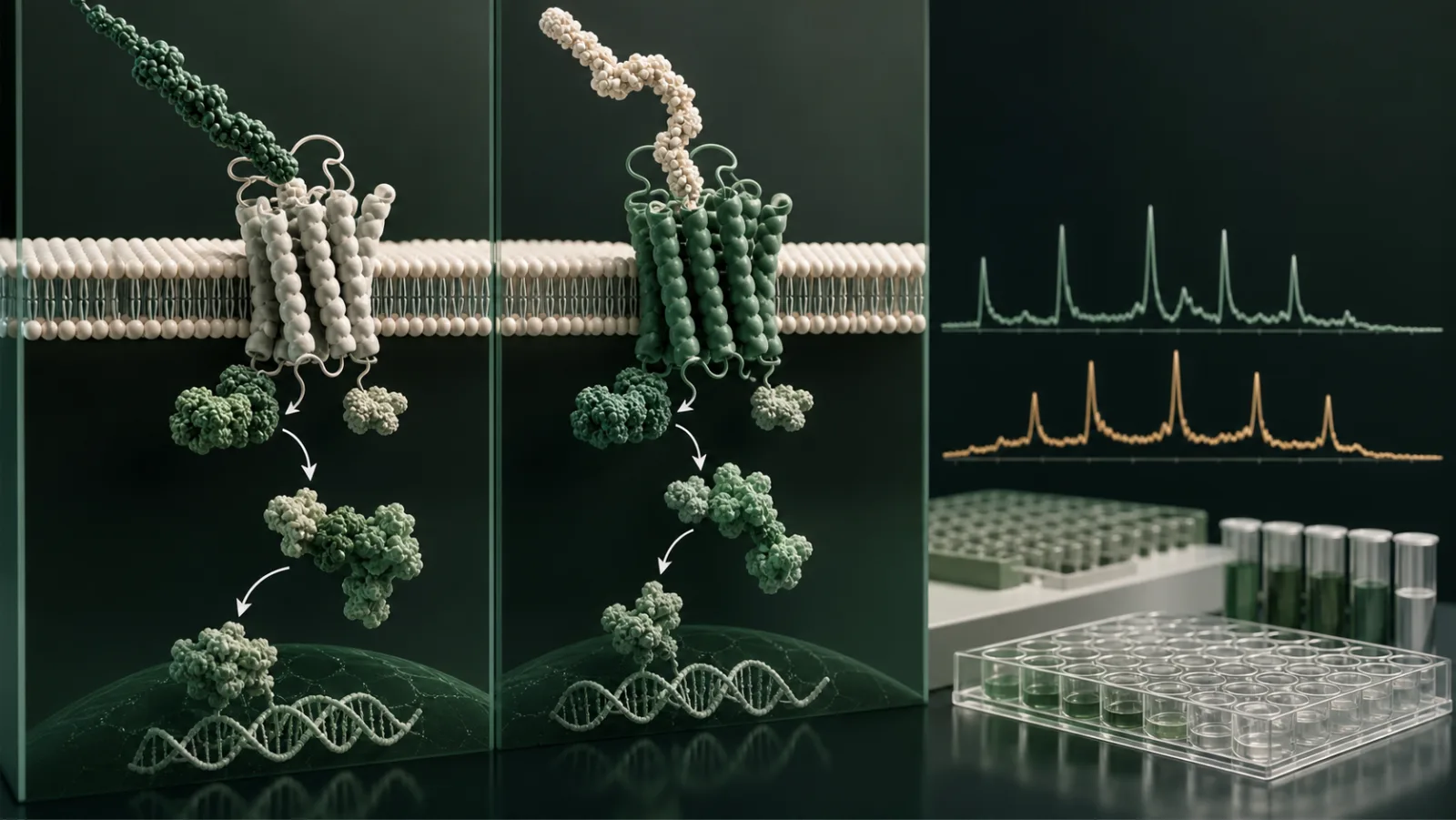
A recombinant GHRH receptor assay can measure proximal signaling such as cyclic AMP under controlled expression. Pituitary-cell or organism models add secretion, feedback and endogenous pulsatility. A compound can show similar receptor potency and different exposure-driven endocrine duration.
Use full concentration-response curves, receptor-null controls and a reference GHRH ligand. For hormone release, collect a time course that captures peaks rather than one fixed sample.
What material attributes affect comparison?
Confirm exact sequence, N-terminal group, salt form, purity and peptide content. Modified and unmodified GHRH analogues may differ in solubility and surface adsorption. Prepare them on the same molar basis and verify delivered concentration at the assay-relevant range.
Protease stability can be measured directly in the selected matrix. Do not infer it only from a prolonged biological readout, which may be shaped by feedback or receptor dynamics.
How should clinical literature be used?
Tesamorelin has compound-specific human trial literature. Those results apply to the studied product, population, endpoints and regulatory setting. They do not validate personal use of research materials or make sermorelin equivalent. North Specs separates published clinical context from catalogue links and supplies products only for qualified laboratory research.
Continue through the evidence
Methods and quality. How to Read a Peptide Certificate of Analysis, HPLC Peptide Purity: How to Read a Chromatogram Without Overclaiming and LC-MS for Peptide Identity: Molecular Mass, Charge States and Sequence Evidence.
Connected peptide briefings. Growth Hormone Secretagogues: GHRH Analogues Versus Ghrelin Mimetics, CJC-1295 With DAC: Albumin Binding and Growth Hormone Axis Research, Ipamorelin and Hexarelin: Ghrelin Receptor Selectivity in Research, Research Peptides in Canada: A Laboratory Procurement Guide, Health Canada, Peptides and Research Use Only: What the 2026 Guidance Means, Shipping and Storing Research Peptides Across Canada, BPC-157 Research: Evidence Gaps and Replication-First Study Design, GHK-Cu Research: Copper Coordination and Experimental Design and PT-141 and Melanotan II: Melanocortin Receptor Selectivity.
Sources and further literature
- Tesamorelin and liver fat research in HIVRandomized clinical research providing compound-specific context, not a general laboratory-use recommendation.
- Tesamorelin clinical trial in HIV-associated abdominal fatHuman study record for historical and mechanistic context.
- Health Canada: Think twice before injecting peptides bought onlineApril 2026 federal warning about unauthorized peptide products.
North Specs separates scientific education from product claims. Review primary literature, current regulations and institutional requirements before designing laboratory work.