Direct answer
How terminal amidation, acetylation and lipid or linker modifications alter peptide mass, charge, stability and experimental interpretation.
- Terminal modifications change molecular mass and often change net charge, conformation or proteolytic stability.
- The modified form must be explicit in the sequence record, theoretical mass and reference standard.
- Incomplete modification creates closely related impurities that require appropriate separation and mass evidence.
Why are peptide termini modified?
Natural peptides may be C-terminally amidated, and synthetic research peptides are sometimes acetylated at the N terminus or amidated at the C terminus to reproduce biology, alter charge or reduce susceptibility to exopeptidases. Other designs add fatty acids, polyethylene-glycol-like spacers, fluorophores or affinity tags.
Each modification defines a different molecular entity. An unmodified sequence and an amidated version should not share one theoretical mass or be treated as interchangeable controls.
How do amidation and acetylation change behavior?
Amidation replaces the terminal carboxylate with an amide and removes a negative charge under common conditions. N-terminal acetylation neutralizes the free amino group. These changes can shift solubility, chromatographic retention, receptor interaction and folding. The effect is sequence-specific rather than a guaranteed increase in stability or activity.
Lipidation adds a large hydrophobic group and can drive albumin binding, membrane association, aggregation or adsorption. Linker identity and attachment site therefore belong in the material description.
How are modifications confirmed?
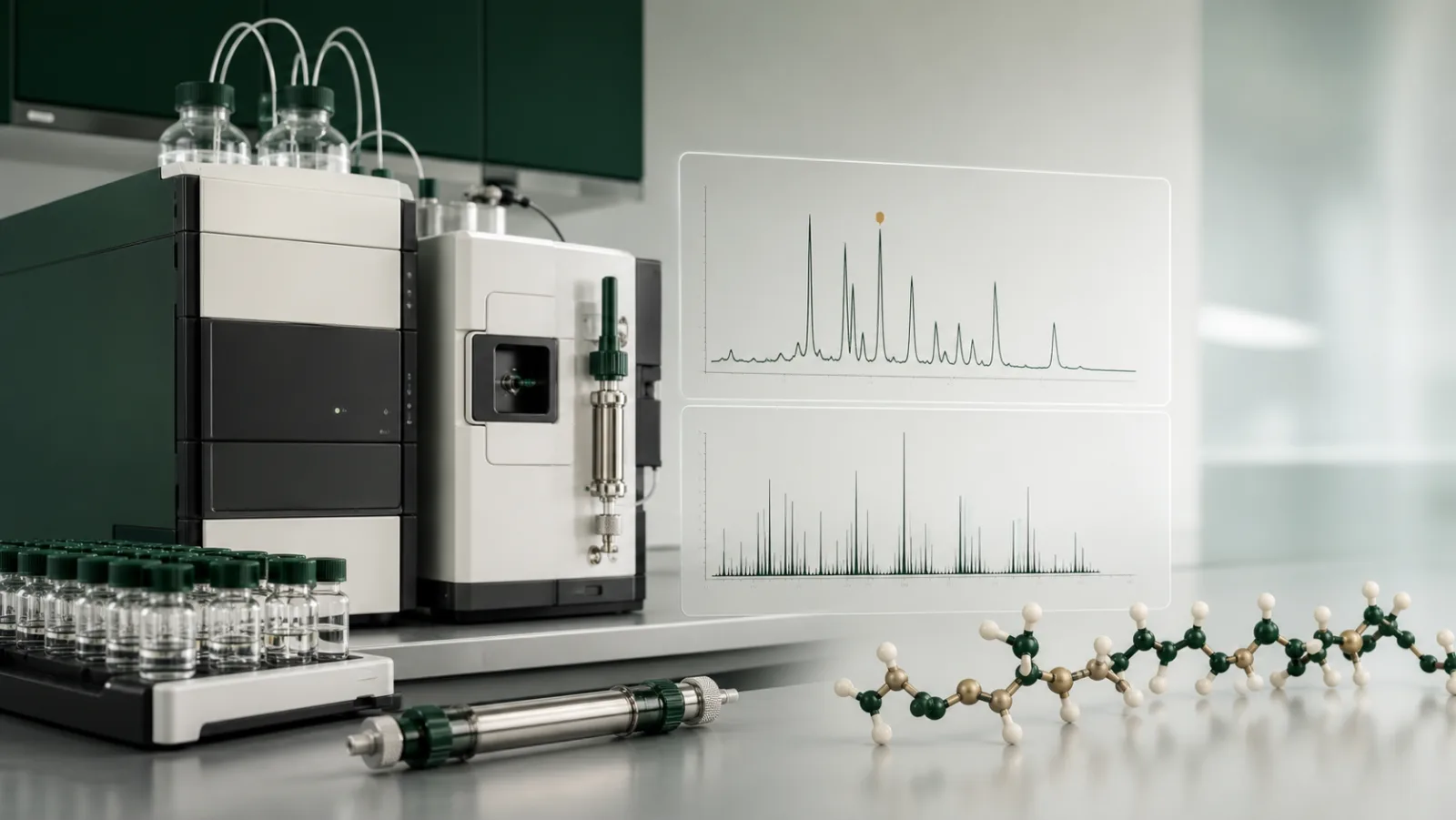
Intact mass should agree with the fully specified chemical form. Tandem MS or peptide mapping can localize a modification when more than one attachment site is possible. HPLC should resolve unmodified or partially modified species to the extent needed for the use. For heterogeneous conjugation, a single mass may be an inadequate description.
Analysts should consider adducts and counter-ions separately from covalent modifications. A mass difference should be assigned using orthogonal evidence rather than matched to the most convenient theoretical explanation.
What belongs in the experimental record?
Record sequence, termini, stereochemistry, attachment site, linker, salt form and content basis. Use the molecular weight for that exact form. If a publication compares variants, match their purity, content and preparation rather than comparing equal gross masses. Precise nomenclature is a reproducibility tool, not a cosmetic detail.
Continue through the evidence
Methods and quality. Albumin Binding and Acylated Peptides: A Research Methods Guide, LC-MS for Peptide Identity: Molecular Mass, Charge States and Sequence Evidence, Peptide Disulfide Bonds, Oxidation and Analytical Confirmation, How to Read a Peptide Certificate of Analysis, HPLC Peptide Purity: How to Read a Chromatogram Without Overclaiming, Peptide Dose-Response Curves: EC50, Emax and Assay Design, GLP-1 Receptor Assay Design: Controls, Curves and Interpretation and Receptor Bias and Potency in Incretin Peptide Research.
Connected peptide briefings. Research Peptides in Canada: A Laboratory Procurement Guide, Health Canada, Peptides and Research Use Only: What the 2026 Guidance Means, Shipping and Storing Research Peptides Across Canada and Incretin Research: GLP-1, GIP and the Move to Multi-Receptor Agonists.
Sources and further literature
- USP: Reference standards to support quality of synthetic peptide therapeuticsPeptide-specific discussion of identity, quality attributes and standards.
- ICH Q2(R2): Validation of Analytical ProceduresInternational framework for validation and method performance.
North Specs separates scientific education from product claims. Review primary literature, current regulations and institutional requirements before designing laboratory work.