Direct answer
Why fatty-acid modification and albumin binding change peptide exposure, free concentration, assay recovery and interpretation.
- Fatty-acid modification can prolong exposure through reversible albumin association and altered clearance.
- Total concentration, free concentration and receptor-accessible concentration are not always the same.
- Albumin source, concentration, temperature and plastic surfaces should be controlled in comparative assays.
Why are peptides acylated?
Short peptides can be rapidly filtered, degraded or cleared. Attaching a fatty-acid moiety through a spacer can increase reversible binding to albumin and reduce access to some clearance pathways. The modification can also influence self-association, solubility and receptor engagement, so it is more than a simple timer.
Semaglutide, tirzepatide and retatrutide illustrate different engineered acylated peptides. Their spacers, attachment positions and sequences are not interchangeable. Researchers should identify the exact analogue rather than use long-acting GLP-1 peptide as a complete description.
What does albumin binding do in an assay?
Albumin can buffer the free concentration of an acylated ligand. It may also reduce nonspecific adsorption and improve apparent recovery. The direction and magnitude depend on albumin concentration, fatty-acid chemistry, medium composition and incubation. A result from protein-free buffer cannot automatically predict a protein-rich system.
Define whether the scientific question concerns intrinsic receptor pharmacology or exposure under a physiological protein condition. For intrinsic comparison, a protein-free system may be informative if recovery is controlled. For an exposure-relevant study, albumin may be essential.
How can binding be measured?
Equilibrium dialysis, ultrafiltration, surface-plasmon methods and other biophysical approaches can estimate protein association, each with potential membrane or surface artefacts. Validate recovery and nonspecific binding. The free fraction can be very sensitive to concentration and matrix.
Pair a binding measurement with a functional assay under defined albumin conditions. A high association percentage does not state how quickly the ligand exchanges or whether the receptor can access it over the assay period.
Which analytical problems can acylation create?
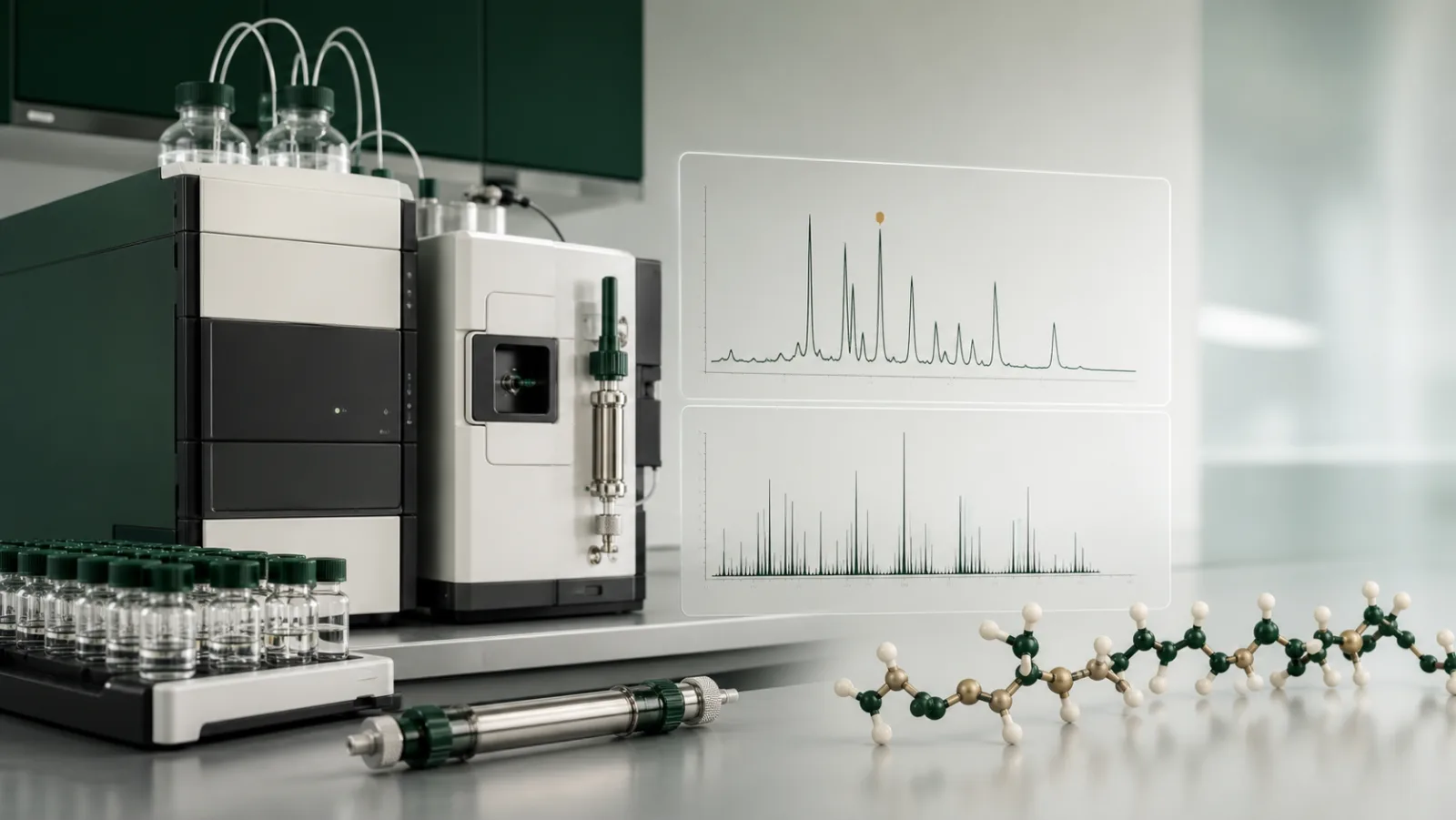
Hydrophobicity can increase retention, adsorption and aggregation. Related impurities can involve incomplete modification, acyl-chain damage, oxidation or sequence variants. LC-MS methods need conditions that recover both the main peptide and plausible related species. A method that loses hydrophobic impurities can overstate purity.
Content calculations should account for water, counter-ions and the full molecular form. When preparing molar solutions, use the molecular weight for the supplied form and a documented peptide-content basis.
What should be reported?
Report albumin species and grade, concentration, temperature, medium, plate type, pre-incubation, ligand preparation and timing. Show whether concentrations are nominal, total measured or free. This detail makes apparently conflicting acylated-peptide results much easier to reconcile.
Continue through the evidence
Methods and quality. How to Read a Peptide Certificate of Analysis, HPLC Peptide Purity: How to Read a Chromatogram Without Overclaiming, LC-MS for Peptide Identity: Molecular Mass, Charge States and Sequence Evidence, Peptide Dose-Response Curves: EC50, Emax and Assay Design and GLP-1 Receptor Assay Design: Controls, Curves and Interpretation.
Connected peptide briefings. Semaglutide: From Peptide Engineering to FDA and Health Canada Milestones, Retatrutide: What Triple-Agonist Research Shows So Far, Low-Binding Tubes and Peptide Adsorption: Preventing Invisible Sample Loss, Peptide Solubility, Aggregation and Buffer Selection, Research Peptides in Canada: A Laboratory Procurement Guide, Health Canada, Peptides and Research Use Only: What the 2026 Guidance Means and Shipping and Storing Research Peptides Across Canada.
Sources and further literature
- Structural insights into retatrutide triple agonismCryo-EM and receptor-structure study, 2024.
- FDA Ozempic prescribing informationCurrent label records initial U.S. approval in 2017.
- LY3437943 triple-agonist phase 1b trialMultiple-ascending-dose trial, The Lancet, 2022.
North Specs separates scientific education from product claims. Review primary literature, current regulations and institutional requirements before designing laboratory work.