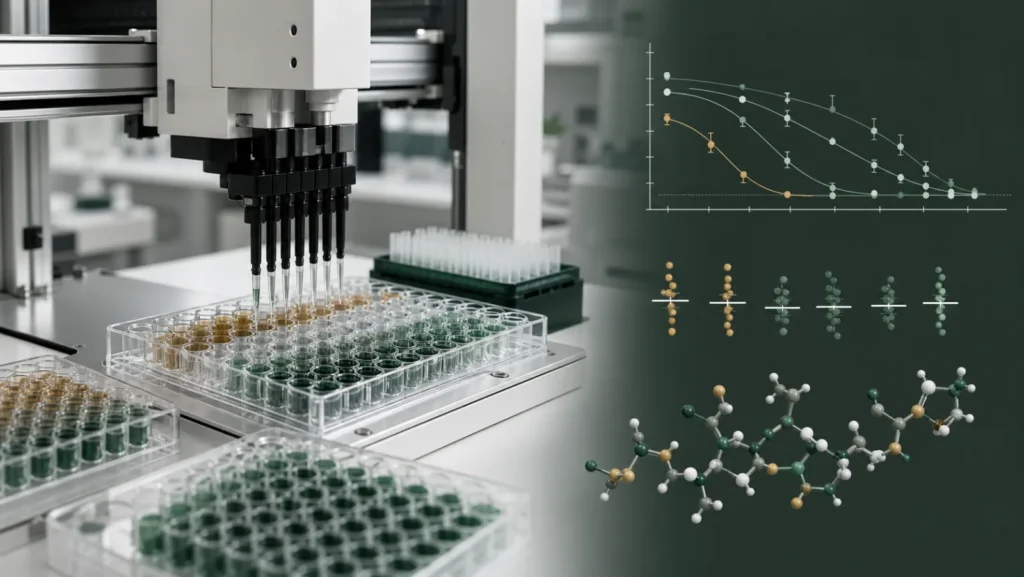
Peptide Dose-Response Curves: EC50, Emax and Assay Design
A laboratory guide to designing and interpreting peptide concentration-response experiments without confusing potency, efficacy and system bias.
Read briefingStrictly for laboratory Research Use Only
Research notes & methods
Cited briefings on peptide science, analytical methods, Canadian research requirements and reproducible laboratory practice.
A laboratory guide to designing and interpreting peptide concentration-response experiments without confusing potency, efficacy and system bias.
Read briefingHow reference standards, secondary standards and system-suitability samples support defensible peptide identification and quantitation.
Read briefingA field-by-field guide to peptide certificates of analysis, including identity, purity, content, counter-ions, dates, traceability and method limitations.
Read briefingEndotoxin, bioburden and sterility answer different questions. This guide helps laboratories select controls appropriate to peptide experiments.
Read briefingSurface adsorption can distort peptide recovery at low concentration. Learn how material, concentration, time and additives change apparent potency.
Read briefingHow to test peptide freeze-thaw stability using realistic cycles, stability-indicating methods, matched controls and meaningful acceptance criteria.
Read briefingA decision framework for selecting peptide solvents and buffers while distinguishing apparent solubility from stable, monomeric recovery.
Read briefingA scientific overview of freeze-drying, residual water, hygroscopicity and the storage records needed to preserve peptide research material.
Read briefingWhy synthetic peptides carry counter-ions, how TFA and acetate affect mass and assays, and what to document when comparing materials.
Read briefingPurity, gross vial mass and net peptide content are not interchangeable. This guide explains how water, counter-ions and salts affect concentration calculations.
Read briefingHow LC-MS supports peptide identity, why charge-state envelopes require deconvolution and when intact mass should be supplemented by sequence-level evidence.
Read briefingA practical guide to interpreting peptide HPLC purity, peak area, wavelength, gradients and the questions a chromatogram cannot answer alone.
Read briefingInstitutional research
Talk with our research support team about batch records, institutional procurement and catalogue availability.